


![[pdf]](icons/pdf.png)
|
|
|
|
| Imaging using compressive sensing | |
|
 given some data
  which
exist
in the same vector space. We have a masking operator
which
exist
in the same vector space. We have a masking operator  (1 where the data is known, 0 elsewhere). We add
in some knowledge of the covariance of the model through a regularization operator
(1 where the data is known, 0 elsewhere). We add
in some knowledge of the covariance of the model through a regularization operator  . We then estimate the
best model from
the following system of equations in a
. We then estimate the
best model from
the following system of equations in a  sense,
 |
|||
 |
(1) |
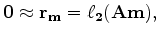 and
and  are the result of taking the
norm
of the first and second equations.
The success of this approach relies on the accuracy of
to describe the covariance of the model.
are the result of taking the
norm
of the first and second equations.
The success of this approach relies on the accuracy of
to describe the covariance of the model.
Compressive sensing approaches the problem from a different perspective. It starts from the notion that
there exists a basis function that
can be transformed into through the
linear operator  in which very few non-zero
elements are needed to represent the signal. The compressive sensing approach is then to set up the missing data problem
in two phases. First, estimate the elements of the sparse basis function
through,
in which very few non-zero
elements are needed to represent the signal. The compressive sensing approach is then to set up the missing data problem
in two phases. First, estimate the elements of the sparse basis function
through,
in the  sense. We can then apply
  to recover the full model.
Compressive sensing makes the claim that if the signal can be represented in this
basis function by
to recover the full model.
Compressive sensing makes the claim that if the signal can be represented in this
basis function by  points, if you collect
  randomly sampled points, where
  is typically 4-5, significantly less
than what the Nyquist-Shannon criteria would suggest.
is typically 4-5, significantly less
than what the Nyquist-Shannon criteria would suggest.
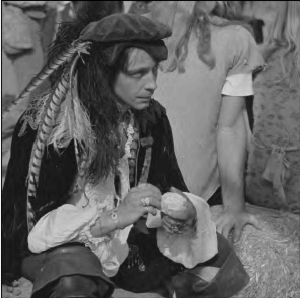
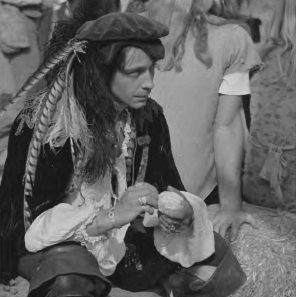
Figure 1 shows an example of this technique applied to a 2-D missing data problem. In this case, we are trying to recover the image seen in Figure 1(a). We start from the data points seen in Figure 1(b), and recover the image seen in Figure 1(c). In this case, the image was subsampled by a factor of 8 and nearly perfect recovery was achieved.

|
|---|
|
before,random,after
Figure 1. The original image (a), the image sub-sampled by a factor of 8 (b), and the reconstructed image (c) using compressive sensing. Baraniuk et al. (2008). |
|
|
Reconstruction using compressive sensing techniques is expensive.  solvers are
significantly more expensive than their
counterparts, which in themselves
can represent a significant cost. As a result, only certain classes of problems
benefit from compressive sensing techniques. For compressive sensing to be useful,
the cost of acquiring the full dataset must be significant. In addition, the signal
must be highly compressible. The following two sections address both criterion.
solvers are
significantly more expensive than their
counterparts, which in themselves
can represent a significant cost. As a result, only certain classes of problems
benefit from compressive sensing techniques. For compressive sensing to be useful,
the cost of acquiring the full dataset must be significant. In addition, the signal
must be highly compressible. The following two sections address both criterion.
|
|
|
|
| Imaging using compressive sensing | |
|
