


![[pdf]](icons/pdf.png)
|
|
|
|
| Residual-moveout analysis in presence of strong lateral velocity anomalies | |
|
Starting from the images shown in the previous section, I performed a conventional residual moveout analysis by applying the following angle-domain moveout
 |
(1) |
 ,
and then computing the stack power from the moved-out ADCIGs.
For constant velocity errors in the half space above the reflector,
the parameter
is approximately related to
the ratio between
the current migration slowness
,
and then computing the stack power from the moved-out ADCIGs.
For constant velocity errors in the half space above the reflector,
the parameter
is approximately related to
the ratio between
the current migration slowness
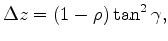 and
the true slowness
and
the true slowness  ;
that is,
;
that is,
 (Biondi and Symes, 2004).
|
|---|
|
Avg-Power-all-0-overn
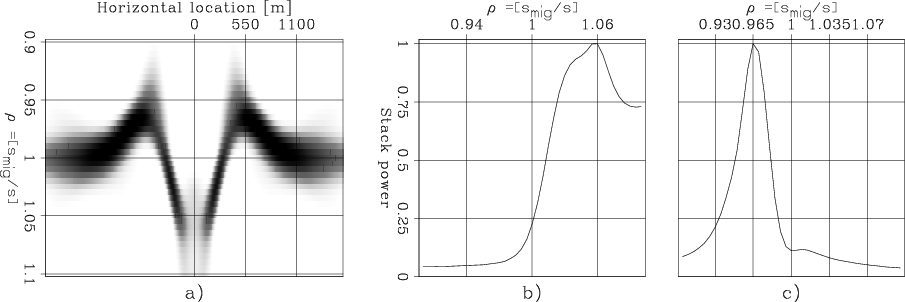
Figure 5. (a) Stack power as a function of horizontal location X and the moveout parameter
, corresponding to the full-bandwidth image
shown in Figure 3.
Graphs of the function in panel a) at
(b) X=0 km, and (c) X=.55 km.
|
|
|
,
averaged over the depth interval of the reflector.
The panels in Figure 5b
and 5c show the graphs of this function at
(b) X= 0 km and (c) X=.55 km.
In the middle of the reflector the residual moveout
is not well described by a one parameter curve,
and thus in Figure 5b
the stack power peak is broad and not well defined.
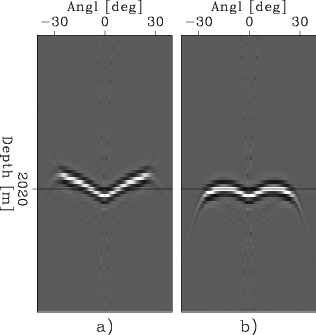
Figure 6 shows the central ADCIG before (a) and
after (b) residual moveout with
=1.06.
Whereas the power of the stack is maximum for
=1.06
(see Figure 5b),
the gather shown in Figure 6b
is far from being flat.
In contrast, at X=.55 km, the residual moveout
is well described by a one-parameter curve and the stack power peak
is sharp and well defined in Figure 5c.
However, at  the stack power curve is almost flat.
If we relied on the numerical derivative of this curve to compute
the velocity gradient, we might be relying on the wrong information.
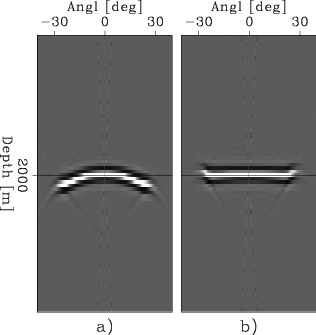
The power of the stack is maximum for
=.965
(see Figure 5c)
and indeed the ADCIG moved-out with this value of
is flat, as shown in Figure 7b.
the stack power curve is almost flat.
If we relied on the numerical derivative of this curve to compute
the velocity gradient, we might be relying on the wrong information.
The power of the stack is maximum for
=.965
(see Figure 5c)
and indeed the ADCIG moved-out with this value of
is flat, as shown in Figure 7b.
|
Rmo-all-X0-overn
Figure 6. ADCIGs at X=0 km before (a) and after (b) residual moveout with
=1.06.
|
|
|---|---|
|
|
|
Rmo-all-X550-overn
Figure 7. ADCIGs at X=.55 km before (a) and after (b) residual moveout with
=.965.
|
|
|---|---|
|
|
A simple solution to the problems identified above could be to
image only the low frequency component of the data.
Figure 8 shows the
stack-power function when computed from the low-frequency image shown in
Figure 4.
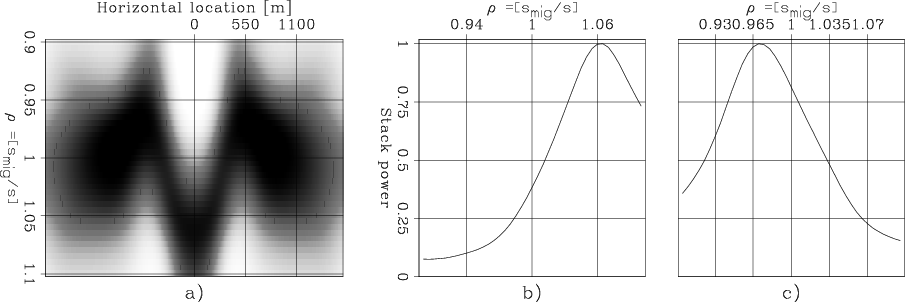
In this case the stack-power peaks are well defined at both X=0 km
and X=.55 km, and they are sufficiently broad that the derivative
of the stack-power with respect to
, evaluated at
,
would provide useful
information for the computation of the velocity gradient.
However, seismic data are not always available with sufficient signal-to-noise
ratio at low frequencies.
In these cases, the challenge can be tackled by smoothing
the stack-power function along the moveout parameter before
evaluating the derivatives.
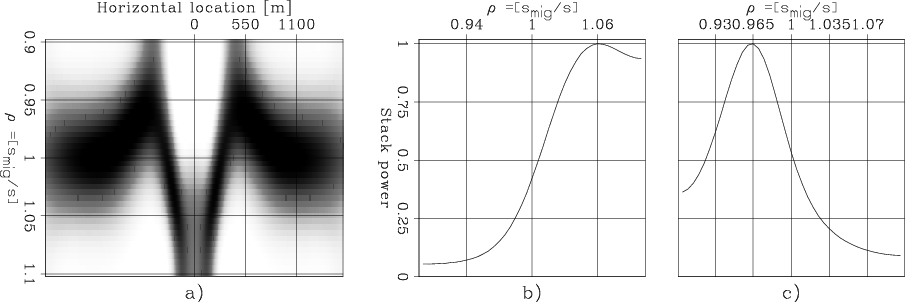
Figure 9 shows the
stack-power function when computed from the full-bandwidth image
and then smoothed along the
axis.
This function has many similarities to the low-frequency one shown in
Figure 8,
but does not require data with good signal-to-noise ratio at low frequencies.
|
|---|
|
Avg-Power-all-0-VLowFreq-overn
Figure 8. (a) Stack power as a function of horizontal location and moveout parameter
corresponding to the low-passed image
shown in Figure 4.
Graphs of the function in panel a) at
(b) X=0 km, and (c) X=.55 km.
|
|
|
|
|---|
|
Smooth-Power-all-0-overn
Figure 9. (a) Stack-power function resulting from smoothing along the
axis the function shown in
Figure 5.
Graphs of the function in panel a) at
(b) X=0 km, and (c) X=.55 km.
|
|
|
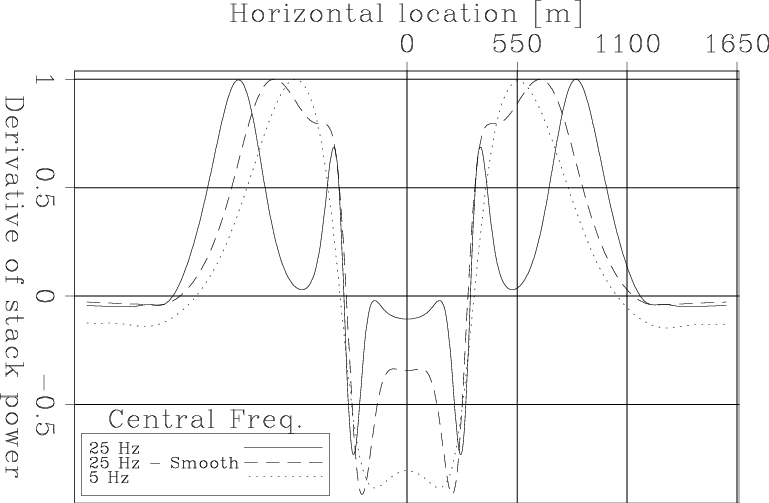
Finally, Figure 10 shows the derivatives
of the stack-power functions shown in the previous three figures,
evaluated numerically at
.
These functions would be the starting data
from which the velocity gradient is computed in a wave-equation
migration velocity analysis method
(Biondi, 2010,2008; Zhang and Biondi, 2011).
The solid line, which corresponds to the full-bandwidth data without
smoothing, would provide misleading information and possibly would prevent
proper convergence of the velocity estimation algorithm.
On the contrary, both the curve computed from the low-frequency data
(dotted line)
and the one obtained by smoothing the stack-power along
(dashed line)
would provide useful information for the computation of the gradient.
|
|---|
|
Der-Power-all-overn
Figure 10. Derivatives of the stack-power functions evaluated numerically at
:
solid line - full-bandwidth data (Figure 5),
dashed line - full-bandwidth data
with smoothing (Figure 9),
dotted line - low-passed
data (Figure 8).
|
|
|
|
|
|
|
| Residual-moveout analysis in presence of strong lateral velocity anomalies | |
|