


![[pdf]](icons/pdf.png)
|
|
|
|
| Fourier methods of seismic data regularisation | |
|
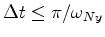
The occurence of spectral leakage is a fundamental product of data reconstruction theory, which can be summarised to say that if a coninuous function is sampled by at least the Nyquist interval, such that
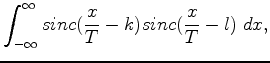
 , then total reconstuction of the input series is completely determined. However a fundamental assumption of this theory is that the basis functions used for reconstruction are orthogonal, and to summarise this assumption can be described as
 |
 |
 |
(1) |
|
 |
(2) |
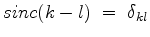 is the Kronecker delta function and
  are integers (Xu and Pham, 2004b). On a regular grid this ensures that the sinc function has value 1 on the original data position, and 0 elsewhere. However, on an irregular grid this condition is violated, and indeed the Nyquist concept is less meaningful. The non-orthoganality of these basis functions leads to a non-orthogananilty of Fourier coefficients, and this causes energy from large Fourier coefficients to `leak' to others in the frequency domain, resulting in a denser, noisier spectrum. An example of this can be seen in Figure 2.
In light of fact that for real data there is always irregularity, whether it is due to cable feathering, obstacles or statics, Fourier regularisation methods must try and reduce or remove spectral leakage. To do this an irregular Fourier transform, its inverse and an appropriate weighting scheme must be devised.
|
|
|
|
| Fourier methods of seismic data regularisation | |
|