![[pdf]](icons/pdf.png)
|
|
|
|
| Poroelastic measurements resulting in complete data sets for granular and other anisotropic porous media | |
|
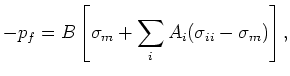
One common example of this type of measurement uses triaxial testing [see Lockner and Stanchits (2002)],
where a two-sided confining stress is defined as
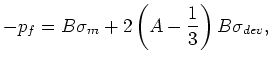 ,
and then the deviatoric stress is determined by
,
and then the deviatoric stress is determined by
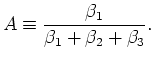 of Skempton (1954).
1.2
 for
for
 , as well as
  , of hexagonal minerals:
cadmium (Cd),
H
, of hexagonal minerals:
cadmium (Cd),
H O ice,
 -quartz (SiO),
titanium (Ti),
and zirconium (Zr).
All data from Simmons and Wang (1971) [entry numbers: 52473,
52563, 52643, 52726, and 52798, respectively],
but re-expressed in units of GPa.
-quartz (SiO),
titanium (Ti),
and zirconium (Zr).
All data from Simmons and Wang (1971) [entry numbers: 52473,
52563, 52643, 52726, and 52798, respectively],
but re-expressed in units of GPa.
| Stiffness | Cadmium (Cd) | HO Ice |
-Quartz |
Titanium (Ti) | Zirconium (Zr) |
 |
115.30 | 13.85 | 116.6 | 163.9 | 137.0 |
 |
51.20 | 14.99 | 110.4 | 181.6 | 160.7 |
 |
39.24 | 7.07 | 16.7 | 91.3 | 75.6 |
 |
40.22 | 5.81 | 32.8 | 68.9 | 65.4 |
|
20.40 | 3.19 | 36.1 | 47.2 | 30.1 |
1.2
 (Voigt, Reuss, and three partial-sum moduli)
for hexagonal minerals: cadmium (Cd),
HO ice,
-quartz (SiO),
titanium (Ti),
and zirconium (Zr).
All data from Simmons and Wang (1971) [see TABLE 5],
while the expressions in the main text were used
for all the computations. All moduli in units of GPa.
(Voigt, Reuss, and three partial-sum moduli)
for hexagonal minerals: cadmium (Cd),
HO ice,
-quartz (SiO),
titanium (Ti),
and zirconium (Zr).
All data from Simmons and Wang (1971) [see TABLE 5],
while the expressions in the main text were used
for all the computations. All moduli in units of GPa.
| Modulus | Cadmium (Cd) | HO Ice |
-Quartz |
Titanium (Ti) | Zirconium (Zr) |
 |
57.89 | 8.90 | 56.47 | 107.51 | 94.17 |
 |
48.61 | 8.90 | 56.37 | 107.50 | 94.02 |
 |
143.07 | 8.94 | 53.97 | 109.00 | 89.58 |
 |
20.95 | 8.82 | 61.86 | 104.63 | 104.36 |
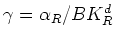
It is not difficult to show that, in terms of our previous definitions
for the triaxial testing geometry, the coefficient is given
precisely by the ratio
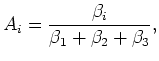 , so this contribution always
vanishes in (54). This fact explains why I did not
encounter this coefficient before in the analysis.
Note that there is no assumption here that the poroelastic system itself is
necessarily transversely isotropic. Only the prescribed equality of
the two applied transverse stresses,
, so this contribution always
vanishes in (54). This fact explains why I did not
encounter this coefficient before in the analysis.
Note that there is no assumption here that the poroelastic system itself is
necessarily transversely isotropic. Only the prescribed equality of
the two applied transverse stresses,
 and
and
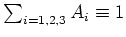 , is assumed.
Then, the formula (54) follows directly from the
equations already presented.
, is assumed.
Then, the formula (54) follows directly from the
equations already presented.
|
|
|
|
| Poroelastic measurements resulting in complete data sets for granular and other anisotropic porous media | |
|