![[pdf]](icons/pdf.png)
|
|
|
|
| Measuring velocity from zero-offset data by image focusing analysis | |
|
The process starts from a partially-focused migrated image
 ,
which is function of spatial coordinate vector
,
which is function of spatial coordinate vector
 ,
and continues with the following steps:
,
and continues with the following steps:
 ,
where the parameter
,
where the parameter  is the ratio between the new migration
velocity and the migration velocity used for the initial migration.
is the ratio between the new migration
velocity and the migration velocity used for the initial migration.
,
to obtain the dip-decomposed images
 ,
where
,
where  is the structural dip.
,
using the local-dip information extracted at step 2.
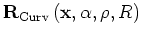
The results of this process are the curvature-corrected images
 ,
where
,
where  is the radius of curvature.
and
by applying the following equation,
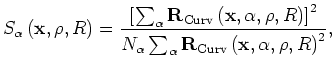 is the number of dips included in the semblance computation.
To perform the residual migration listed in step 1 of the procedure
outlined above I used the linearized
residual migration described in the Appendix of
Biondi (2008).
Other residual migration methods could be used,
such as the one presented in
Sava (2003).
To simplify the analysis, I remapped the residual-migrated sections
to pseudo-depth; that is, I remapped the depth axis
of residual-migrated images
according to the relationship
 ,
where
,
where  is pseudo-depth
(Sava, 2004).
is pseudo-depth
(Sava, 2004).
To estimate the local structural dips required by step 2,
I used the Seplib program Sdip that implements
a variant of the algorithms described by Fomel (2002).
Any other local-dips estimator would be suitable.
When performing the curvature correction at step 4,
I define the curvature to be positive if the reflector
frowns down (e.g. anticline) and negative if the reflector smiles up
(e.g. syncline).
The parameter
required for evaluating the focusing semblance
at step 5 can be spatially varying
according to the actual dip spectrum in the image.
I kept it constant for my tests.
|
|
|
|
| Measuring velocity from zero-offset data by image focusing analysis | |
|