|
 |
 |
 | Modeling, migration, and inversion in the generalized source and receiver domain |  |
![[pdf]](icons/pdf.png) |
Next: encoded sources
Up: Modeling, migration, and inversion
Previous: introduction
By using the Born approximation to the two-way wave equation, the primaries can be modeled by a linear operator as follows:
 |
|
|
(A-1) |
where
 is the modeled data for a single frequency
  with source and receiver located at
 and
and
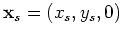 on the surface;
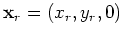 and
and
 are the Green's functions connecting
the source and receiver, respectively, to the image point
are the Green's functions connecting
the source and receiver, respectively, to the image point
 in the
subsurface; and
in the
subsurface; and
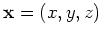 denotes the reflectivity at image point
  .
In Equation 1, we assume
.
In Equation 1, we assume  and
and  are infinite in extent and independent of each other.
For a particular survey, however, we do not have infinitely long cable and infinitely many sources;
thus we have to introduce an acquisition mask matrix to limit the size of the modeling. We define
are infinite in extent and independent of each other.
For a particular survey, however, we do not have infinitely long cable and infinitely many sources;
thus we have to introduce an acquisition mask matrix to limit the size of the modeling. We define
 |
|
|
(A-2) |
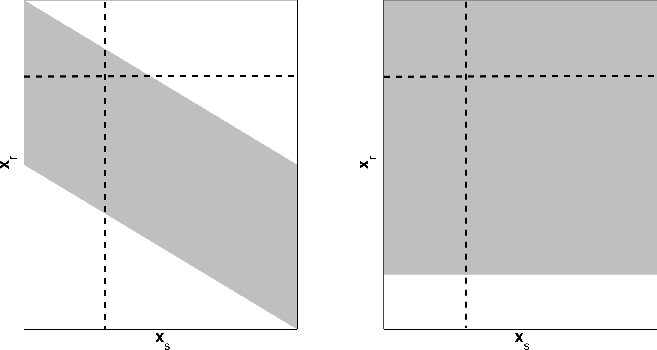
For the marine acquisition geometry,
 is similar to a band-limited diagonal matrix;
for Ocean Bottom Cable (OBC) or land acquisition geometry, where all shots share the same receiver array,
is a rectangular matrix.
Figure 1 illustrates the acquisition mask matrices for these two typical geometries in 2-D cases.
is similar to a band-limited diagonal matrix;
for Ocean Bottom Cable (OBC) or land acquisition geometry, where all shots share the same receiver array,
is a rectangular matrix.
Figure 1 illustrates the acquisition mask matrices for these two typical geometries in 2-D cases.
|
|---|
acquisition-mask
Figure 1. Acquisition mask matrices for different geometries in 2-D cases. Greys denote ones while whites denote zeros.
The left panel shows the acquisition mask matrix for a typical marine acquisition geometry;
the right panel shows the acquisition mask matrix for a typical OBC or land acquisition geometry. [NR]
|
|---|
![[png]](icons/viewmag.png)
|
|---|
To find a model that best fits the observed data, we can minimize the following data-misfit function in the least-squares sense:
 |
|
|
(A-3) |
The gradient of the above objective function gives the conventional shot-profile migration algorithm:
 |
|
|
(A-4) |
where  denotes the real part of a complex number and
  means the complex conjugate;
 is the weighted residual defined as follows:
 |
|
|
(A-5) |
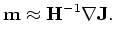
The gradient or migration is only a rough estimate of the model
; to get a better recovery of the model space, the inverse of the Hessian,
the second derivatives of the objective function, should be applied to the gradient:
 |
|
|
(A-6) |
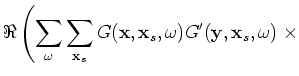
The Hessian can be explicitly constructed by taking the second-order derivatives of the objective function with respect to the model parameters
as follows (Tang, 2008; Plessix and Mulder, 2004; Valenciano, 2008):
where 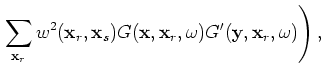 is a neighbor point around the image point in the subsurface.
Valenciano (2008) demonstrates that the Hessian can be directly computed using the above formula; however it requires storing a large number of Green's functions,
which is inconvenient for dealing with large 3-D data set. Tang (2008) shows that with some minor alteration of Equation 7,
an approximate Hessian can
be efficiently computed using the phase-encoding method.
However, Tang (2008) focuses more on the algorithm development, and the physics behind the Hessian by phase-encoding has not been carefully discussed.
In this companion paper, I complete the discussion of the actual physics behind using phase-encoding methods,
such as plane-wave phase encoding and random phase encoding, to obtain the Hessian. In the subsequent sections,
I start with the modeling equation in the encoded source, encoded receiver and simultaneously encoded source and receiver domains.
I show that the corresponding imaging Hessian in the generalized source and receiver domain is the same as
those phase-encoded Hessians discussed in Tang (2008).
|
|
|
|
| Modeling, migration, and inversion in the generalized source and receiver domain | |
|
Next: encoded sources
Up: Modeling, migration, and inversion
Previous: introduction
2009-04-13