


![[pdf]](icons/pdf.png)
|
|
|
|
| Seismic interferometry versus spatial auto-correlation method on the regional coda of the NPE | |
|
 samples at a 125 Hz sampling frequency) at 610 stations with a 45-foot spacing. The second recording starts a few seconds after the first recording ends. Although the exact location of the NPE array is unknown, the data shows that the first 66 stations were located at an angle with respect to the other stations. Starting from station 67 located at
 in Figure 2, 512 stations are analyzed. The first arrivals were muted from the first record. All records were filtered in the frequency-wavenumber domain with a high-cut cosine filter centered around an angle corresponding to a velocity of
 , determined from Figure 3. This removes noise from the coda and interpolates the missing traces. For velocities smaller and equal to
this did not affect the estimation of the surface wave velocity as described below.
, determined from Figure 3. This removes noise from the coda and interpolates the missing traces. For velocities smaller and equal to
this did not affect the estimation of the surface wave velocity as described below.
The spectrum at each station was estimated using a multitaper spectral-estimation technique. This provides several statistically independent estimates of the spectrum and decreases spectral leakage (Prieto et al., 2007,2008b). In this procedure, a time record with  samples is first multiplied with a set of
  orthogonal Slepian tapers (Thomson, 1982). Second, the discrete Fourier transformation is computed for each tapered trace as follows:
 |
(12) |
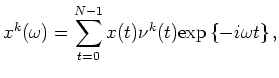 Slepian taper is denoted by
  . The cross-spectrum
 between two traces
  and
and  is calculated from the spectral estimations
 and
and
 according to
 |
(13) |
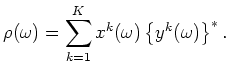 . To enhance the signal-to-noise ratio, the retrieved gathers are smoothed over 50 midpoints, corresponding to a length of
 .
.
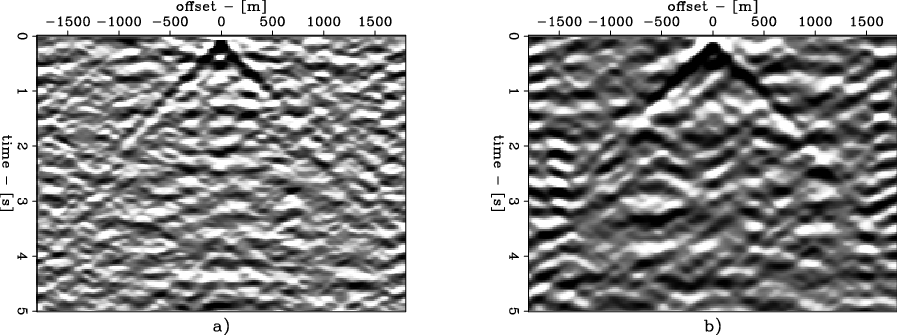
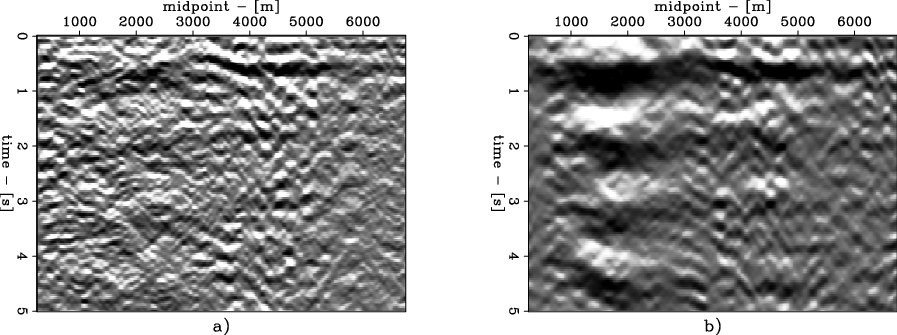
We first study the result from processing the records in the time domain, as is common in seismic interferometry practices. A common-midpoint section at
 is given in Figure 4, and a common-offset section for
 is given in Figure 5. de Ridder (2008) did not observe any event, besides the surface-wave events intersecting each other at
 that is coherent across different midpoints. When we study the common-offset section in Figure 5, we can see the arrival time of the surface wave event at
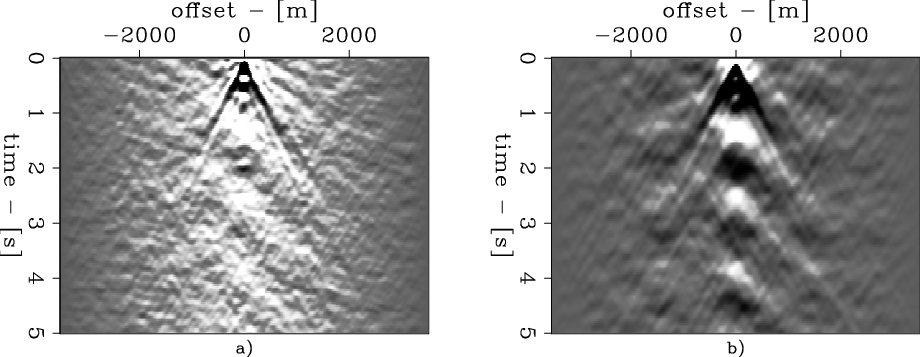
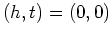 slightly varying with offset. If we neglect this and assume the earth is horizontally layered, the recovered gathers can be stacked over common-offsets as shown in Figure 6. Estimating the slope of the event visible in Figures 4 and 6, de Ridder (2008) found a velocity of
 . The subscript
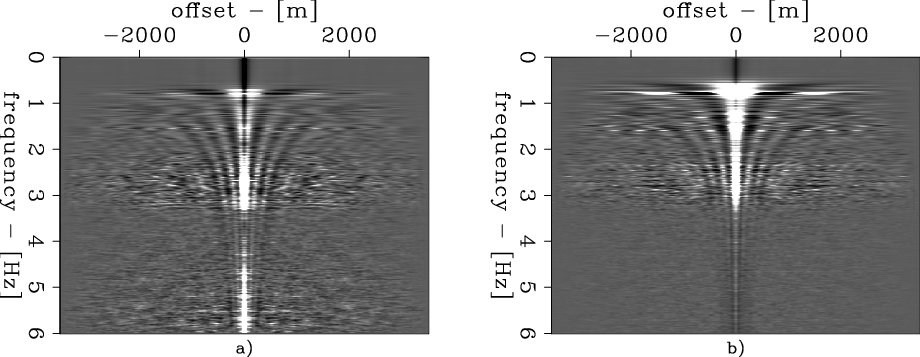
 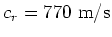 refers to a Rayleigh wave, which is the dominant surface-wave type recorded in the vertical component of particle velocity in groundroll. It is difficult to extract more information from the time-domain images. Additional analysis of the retrieved gathers can be performed in the frequency-domain, by inverting for phase velocity and attenuation factors. The frequency-domain equivalents of the time-domain gathers in Figures 4 and 6 are shown respectively in Figures 7 and 9.
|
|---|
|
si375m
Figure 4. Interferometric common-midpoint gather gather, at ; a) retrieved from recording 1, b) retrieved from recording 2. [ER]
|
|
|
|
|---|
|
si375o
Figure 5. Interferometric common-offset gather, for ; a) retrieved from recording 1, b) retrieved from recording 2. [ER]
|
|
|
|
|---|
|
SIHS
Figure 6. Common-offset stack for the interferometric gathers; a) retrieved from recording 1, b) retrieved from recording 2. [ER] |
|
|
|
|---|
|
SPACHS
Figure 7. Frequency-domain common-offset stack; a) retrieved from recording 1, b) retrieved from recording 2. [ER] |
|
|
|
|
|
|
| Seismic interferometry versus spatial auto-correlation method on the regional coda of the NPE | |
|