


![[pdf]](icons/pdf.png)
|
|
|
|
| Hubbert math | |
|
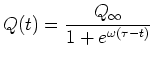 -space is a straight line,
then you have bought equation (2).
If you buy any one of equations (1),(2),(3), or (4),
then you have bought them all because they are mathematically equivalent.
Starting from the definition (4) using the rule from calculus that
-space is a straight line,
then you have bought equation (2).
If you buy any one of equations (1),(2),(3), or (4),
then you have bought them all because they are mathematically equivalent.
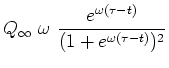
Starting from the definition (4) using the rule from calculus that
 yields equation (3).
 |
 |
 |
(5) |
 |
|
 |
(6) |
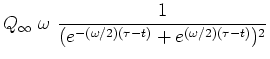
Equation (4) allows us to eliminate the denominator in
equation (5) getting equation (2)
 |
|
 |
(7) |
|
|
 |
(8) |
|
|
 |
(9) |
|
|
 |
(10) |
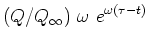
which is equation (2).
Multiplying both sides by 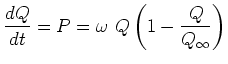 gives equation (1).
|
|
|
|
| Hubbert math | |
|