


![[pdf]](icons/pdf.png)
|
|
|
|
| Anti-crosstalk | |
|
We seemed to escape nonlinearity in the lake depth sounding example above, but that was a lucky accident. Since the data there was mostly explained by geography with a small perturbation by rain and drain, the crosstalk while fundamentally nonlinear was practically linear. More generally anti-crosstalk strategies seem little (if ever!) developed because they lead us directly into nonlinear regression. Let us work through the general case, the nonlinear theory.
Consider data  a shot gather or CMP gather.
We might choose to model it as reflections (hyperbolas)
a shot gather or CMP gather.
We might choose to model it as reflections (hyperbolas)
 plus
linear events
plus
linear events
 (noises or head waves).
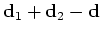
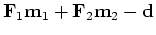
We might thus set up the regression
(noises or head waves).
We might thus set up the regression
 |
 |
 |
(4) |
|
|
 |
(5) |
 and
and
 which for simplicity of exposition
I will take to be
which for simplicity of exposition
I will take to be
 and
and
 .
Is that all there is to this problem?
Not necessarily.
We'll be annoyed if we discover a lot of cross talk between
and
.
Two different physical mechanisms are supposed to have created our data.
We'll be annoyed to discover they both make the same contribution
or that they make opposite contributions.
The regularization should reduce (or prevent)
the contributions from coming out opposite.
If they are opposites, it could represent our lack of analytic skills
in formulating the regularization,
or it could represent our need for the anti-crosstalk methodology
being proposed here.
.
Is that all there is to this problem?
Not necessarily.
We'll be annoyed if we discover a lot of cross talk between
and
.
Two different physical mechanisms are supposed to have created our data.
We'll be annoyed to discover they both make the same contribution
or that they make opposite contributions.
The regularization should reduce (or prevent)
the contributions from coming out opposite.
If they are opposites, it could represent our lack of analytic skills
in formulating the regularization,
or it could represent our need for the anti-crosstalk methodology
being proposed here.
We'd like that the modeled data parts
and
do not "look like" each other.
It's not enough that the dot product
 vanish.
That dot product should be small under all shifted
(say triangular) weighting windows.
Since
is a linear function of the model
and likewise for
,
the orthogonality we seek
involves the product of
with
so our goals are a non-linear function of our unknowns.
Never fear. We have done non-linear problems before.
They don't turn out badly when
we are able to define a good starting location
(which we do by solving the linearized non-linear problem first).
vanish.
That dot product should be small under all shifted
(say triangular) weighting windows.
Since
is a linear function of the model
and likewise for
,
the orthogonality we seek
involves the product of
with
so our goals are a non-linear function of our unknowns.
Never fear. We have done non-linear problems before.
They don't turn out badly when
we are able to define a good starting location
(which we do by solving the linearized non-linear problem first).
|
|
|
|
| Anti-crosstalk | |
|