![[pdf]](icons/pdf.png)
|
|
|
|
| Angle-domain common-image gathers in generalized coordinates | |
|
 , of rays connecting the source-reflector and
reflector-receiver paths to changes in the subsurface offset,
, of rays connecting the source-reflector and
reflector-receiver paths to changes in the subsurface offset,
 , and depth,
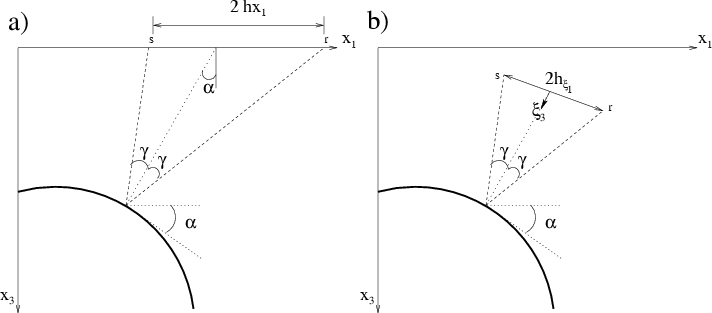
  , coordinates. Figure 1a shows
the geometry of the variables described above.
, coordinates. Figure 1a shows
the geometry of the variables described above.
|
|---|
|
rays
Figure 1. Zoomed in view illustrating reflection opening angle geometry. a) Cartesian coordinates. b) Generalized coordinates. Adapted from Sava and Fomel (2003). [NR] |
|
|
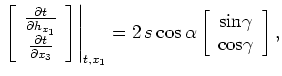 is slowness,
  is reflector dip, and
  is the
reflection opening angle. Using the implicit functions theory,
equations 1 can be rewritten as
is the
reflection opening angle. Using the implicit functions theory,
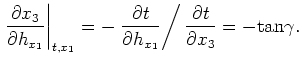
equations 1 can be rewritten as
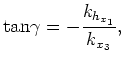 and
and  are the wavenumbers in the
and
are the wavenumbers in the
and  directions, respectively. Note that because
equation 2 does not depend explicitly on
directions, respectively. Note that because
equation 2 does not depend explicitly on
 , we may use Fourier-based methods to calculate the
opening angle, , directly.
, we may use Fourier-based methods to calculate the
opening angle, , directly.
|
|
|
|
| Angle-domain common-image gathers in generalized coordinates | |
|
![$\displaystyle \left. \left[ \begin{array}{c}
\frac{\partial t}{\partial h_{x_1}...
...eft[ \begin{array}{c}
{\rm sin} \gamma \\ {\rm cos} \gamma
\end{array} \right],$](img7.png)