 |
 |
 |
 | Plane-wave migration in tilted coordinates |  |
![[pdf]](icons/pdf.png) |
Next: Wavefield extrapolation in tilted
Up: Shan and Biondi: Plane-wave
Previous: One-way wave equation migration
Shot gathers can also be synthesized into a new dataset to represent a physical experiment that is not performed
in reality. One of the most important examples is to synthesize shot gathers into plane-wave source gathers.
A plane-wave source gather represents what would be recorded if a planar source were excited at the surface with
geophones covering the whole area.
It can also be regarded as the accurate phase-encoding of the shot gathers (Liu et al., 2002).
Plane-wave source gathers can be generated by slant-stacking receiver gathers. The process can be described as follows:
 |
(6) |
where  is the ray parameter for the
  -axis,
  is the source location, and
  is the receiver location at the surface.
Its corresponding plane-wave source wavefield at the surface is
is the receiver location at the surface.
Its corresponding plane-wave source wavefield at the surface is
 |
(7) |
As with the Fourier transformation, we can transform the plane-wave source gathers back to shot gathers by inverse
slant-stacking (Claerbout, 1985) as follows:
 |
(8) |
In contrast to the inverse Fourier transformation, the kernel of the integral is weighted by the angular frequency 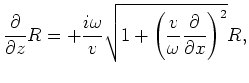 .
This inverse transformation weighting function is also called
.
This inverse transformation weighting function is also called  filter in Radon-transform literature.
As with shot-profile migration, there are two steps to migrate a plane-wave source gather by a typical plane-wave migration method.
First, the source wavefield  and receiver wavefield
  are extrapolated into all depths in the subsurface independently, using the one-way wave equations 2 and 3, respectively.
Second, the image of a plane-wave source with a ray parameter is constructed by cross-correlating
the source and receiver wavefields weighted with the angular frequency :
are extrapolated into all depths in the subsurface independently, using the one-way wave equations 2 and 3, respectively.
Second, the image of a plane-wave source with a ray parameter is constructed by cross-correlating
the source and receiver wavefields weighted with the angular frequency :
 |
(9) |
where  is the conjugate complex of the source wavefield .
The whole image is formed by stacking the images of all possible plane-wave sources:
is the conjugate complex of the source wavefield .
The whole image is formed by stacking the images of all possible plane-wave sources:
 |
(10) |
Because both slant-stacking and migration are linear operators, the image of the plane-wave migration  is equivalent
to the image obtained by shot-profile migration (Liu et al., 2002; Zhang et al., 2005). In the discrete form, in practice we need a
sufficient number of to make the two images equivalent.
is equivalent
to the image obtained by shot-profile migration (Liu et al., 2002; Zhang et al., 2005). In the discrete form, in practice we need a
sufficient number of to make the two images equivalent.
|
|
|
|
| Plane-wave migration in tilted coordinates | |
|
Next: Wavefield extrapolation in tilted
Up: Shan and Biondi: Plane-wave
Previous: One-way wave equation migration
2007-09-18