 |
 |
 |
 | Angle domain common image gathers for steep reflectors |  |
![[pdf]](icons/pdf.png) |
Next: Angle gathers by plane-wave
Up: Shan and Biondi: Angle
Previous: Angle domain CIGs by
Reverse-time migration, based on the two-way wave equation, handles high-angle energy and overturned waves naturally.
In downward continuation migration, source and receiver wavefields are extrapolated along the  -axis and
the subsurface offset direction (the horizontal direction) is normal to the extrapolation direction (the vertical direction).
In contrast, in reverse-time migration the source wavefield
-axis and
the subsurface offset direction (the horizontal direction) is normal to the extrapolation direction (the vertical direction).
In contrast, in reverse-time migration the source wavefield
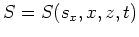 and the receiver wavefield
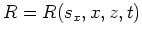 are extrapolated along the time axis,
where
are extrapolated along the time axis,
where  is the source location,
  is the horizontal location,
is the vertical location and
is the horizontal location,
is the vertical location and  is the travel-time. There is no functional difference between the
-axis and -axis.
Therefore, we can obtain general-direction subsurface offset CIGs in reverse-time migration and
conventional horizontal offset and vertical offset are only two special cases (Biondi and Shan, 2002).
As with downward continuation migration, in reverse-time migration horizontal offset domain CIGs are formed by cross-correlating source
and receiver wavefields with a horizontal shift
is the travel-time. There is no functional difference between the
-axis and -axis.
Therefore, we can obtain general-direction subsurface offset CIGs in reverse-time migration and
conventional horizontal offset and vertical offset are only two special cases (Biondi and Shan, 2002).
As with downward continuation migration, in reverse-time migration horizontal offset domain CIGs are formed by cross-correlating source
and receiver wavefields with a horizontal shift  as follows:
 |
(3) |
where the shift is called horizontal subsurface offset.
Similarly, vertical offset domain CIGs are formed by
cross-correlating source and receiver wavefields with a vertical shift  as follows:
 |
(4) |
where the shift is called vertical subsurface offset.
As with downward continuation migration, we can apply equation 2 to transform the horizontal offset domain
CIGs  to angle domain CIGs
 .
Similarly, we can also transform the vertical offset domain CIGs
.
Similarly, we can also transform the vertical offset domain CIGs  to angle domain CIGs
 as follows:
 |
(5) |
where  and
and  are wavenumbers corresponding to and , respectively.
Horizontal CIGs work well for flat reflectors but they are not reliable for steep reflectors,
while vertical CIGs are good for steep reflectors.
Both vertical and horizontal CIGs are not robust for an area with complex geology, where
reflectors have a full range of dips. For a image point, the subsurface offset that parallels the dip direction of the
reflector is called geologic offset.
CIGs would be robust if we used geologic offset for each image point.
However, it is too expensive to generate geologic offset CIGs directly.
Biondi and Symes (2004) demonstrate that the geologic offset
are wavenumbers corresponding to and , respectively.
Horizontal CIGs work well for flat reflectors but they are not reliable for steep reflectors,
while vertical CIGs are good for steep reflectors.
Both vertical and horizontal CIGs are not robust for an area with complex geology, where
reflectors have a full range of dips. For a image point, the subsurface offset that parallels the dip direction of the
reflector is called geologic offset.
CIGs would be robust if we used geologic offset for each image point.
However, it is too expensive to generate geologic offset CIGs directly.
Biondi and Symes (2004) demonstrate that the geologic offset  , horizontal offset , and vertical offset can be linked by the following relationships:
where  is the dip angle of the reflector. The relationships (equations 6 and 7) also show
why horizontal CIGs fail at steeply dipping reflectors. Large horizontal subsurface offset is needed to get
reliable angle domain CIGs for a steep reflector. For the extreme case that the reflector is vertical, from equation 6 we need infinite horizontal subsurface offset.
is the dip angle of the reflector. The relationships (equations 6 and 7) also show
why horizontal CIGs fail at steeply dipping reflectors. Large horizontal subsurface offset is needed to get
reliable angle domain CIGs for a steep reflector. For the extreme case that the reflector is vertical, from equation 6 we need infinite horizontal subsurface offset.
Although neither vertical nor horizontal CIGs are robust, robust angle domain CIGs can be constructed by merging them as follows (Biondi and Symes, 2004):
 |
(8) |
where  is the dip angle at the location
  . Equation 8 is performed in
the Fourier domain
. Equation 8 is performed in
the Fourier domain  , in which the dip angle of the reflector can be calculated accurately.
|
|
|
|
| Angle domain common image gathers for steep reflectors | |
|
Next: Angle gathers by plane-wave
Up: Shan and Biondi: Angle
Previous: Angle domain CIGs by
2007-09-18


