


![[pdf]](icons/pdf.png)
|
|
|
|
| Accelerating seismic computations using customized number representations on FPGAs | |
|
In the profiling stage, the major objective is to collect range and distribution information for the variables. The idea of our approach is to instrument every target variable in the code, adding function calls to initialize data structures for recording range information and to modify the recorded information when the variable value changes.
For the range information of the target variables (variables to map into the circuit design), we keep a record of four specific points on the axis, shown in figure 2.
|
axis
Figure 2. |

|
|---|---|
|
|
The points  and
and  presents the values far away from
zero, i.e., the maximum absolute values that need to be represented.
Based their values, the integer bit-width of fixed-point numbers can
be determined. Points
presents the values far away from
zero, i.e., the maximum absolute values that need to be represented.
Based their values, the integer bit-width of fixed-point numbers can
be determined. Points  and
and  represent the values close the
zero, i.e., the minimum absolute values that need to be represented.
Using the minimum and maximum values, the exponent bit-width of
floating-point numbers and integer bit-width of logarithmic numbers
can be determined.
represent the values close the
zero, i.e., the minimum absolute values that need to be represented.
Using the minimum and maximum values, the exponent bit-width of
floating-point numbers and integer bit-width of logarithmic numbers
can be determined.
For the distribution information of each target variable, we keep a
number of buckets to store the frequency of values at different
intervals. Fig. 3 shows the distribution
information recorded for the real part of variable wfld (a complex
variable). In each interval, the frequency of positive and negative
values are recorded separately. The results show that, for the real
part of variable wfld, in each interval, the frequencies of
positive and negative values are quite similar, and the major
distribution of the values falls into the range  to
to  .
.
|
range-wfld
Figure 3. Range distribution of the real part of variable `wfld'. The leftmost bucket with index  is reserved for zero values.
The other buckets with
index
is reserved for zero values.
The other buckets with
index store the values in the range store the values in the range
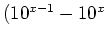 . .
|

|
|---|---|
|
|
The distribution information provides a rough metric for the users to make an initial guess about which number representations to use. If the values of the variables cover a wide range, floating-point and logarithmic number formats are usually more suitable. Otherwise, fixed-point numbers shall be enough to handle the range.
|
|
|
|
| Accelerating seismic computations using customized number representations on FPGAs | |
|