![[pdf]](icons/pdf.png)
|
|
|
|
| Accelerating seismic computations using customized number representations on FPGAs | |
|
Precision and range are key resources to be traded off against the
performance of a computation. We looked at three different types of
number representation: fixed-point, floating-point and logarithmic.
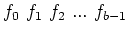
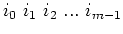
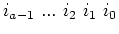
Consider the case when  is represented as a fixed-point
number, with an integer part
is represented as a fixed-point
number, with an integer part  which is
  bits in length, and a
fraction part
bits in length, and a
fraction part  which is
  bits in length.
 |
 |
The integer bit-width, which represents the dynamic range of the number, is calculated according to equation (1):
 |
(1) |
For the floating-point number system, let represent a
floating-point number
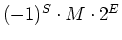 , where
  is
the sign bit,
is
the sign bit,  is the mantissa with a bit-width of
  bits, and
 is the exponent with a bit-width of
  bits.
bits.
The value of the mantissa is expressed as:
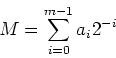 |
(2) |
where
 .
.
It is possible to relate the bit-width of the mantissa of the
node to the error when representing the mantissa by a finite
bit-width  , as follows:

where is the value of the exponent at the node.
Since there is no standard to encode logarithmic numbers, in this report we use a fixed-point format to store the logarithmic value.
|
|
|
|
| Accelerating seismic computations using customized number representations on FPGAs | |
|