


![[pdf]](icons/pdf.png)
|
|
|
|
| |
|
 on the non-stationary filters for the
primaries and the multiples. For the sake of simplicity, I used the same
regularization for both.
on the non-stationary filters for the
primaries and the multiples. For the sake of simplicity, I used the same
regularization for both.
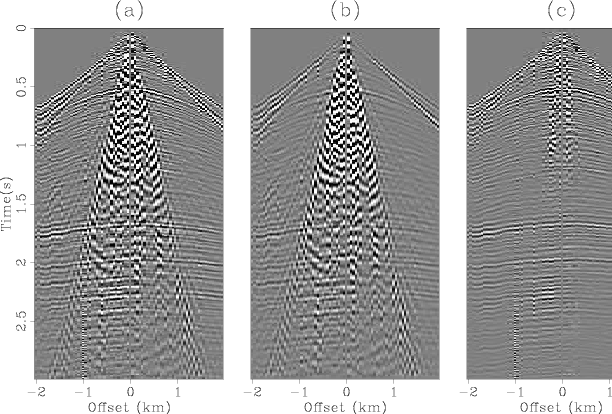
Figure 15 shows the original shot as well as the initial estimates of the body waves and the ground-roll. The ground-roll estimate was computed simply by high-cut filtering the data to 24 Hz using a Butterworth filter with six poles. I allowed significant energy from the body waves to leak into the estimate of the ground-roll to illustrate the problem described in the previous paragraph. Similarly, the estimate of the body waves was computed by low-cut filtering the data to 18 Hz also with a Butterworth filter with 6 poles. Since I don't want to reduce the low frequency components of the signal too much, I allowed strong ground-roll to leak into the estimate of the body waves. The purpose is to eliminate this ground-roll without hurting the signal and ideally, mapping back some of the body-waves from the estimate of the ground-roll.
|
|---|
|
shot1-estimates1
Figure 15. Land shot gather with strong ground-roll (a), initial estimate of ground-roll (b), and body waves (c). |
|
|
|
|---|
|
shot1-matched-bw
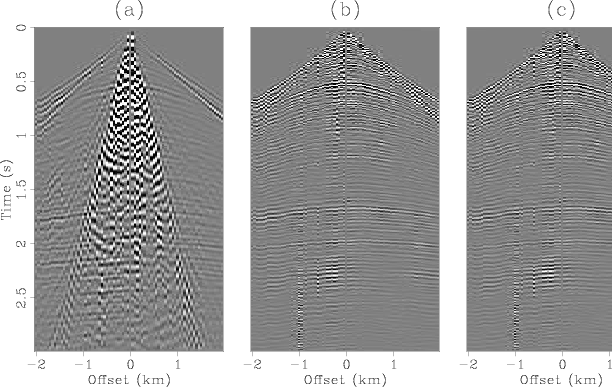
Figure 16. Estimate of body waves after one outer iteration (a), after 5 outer iterations (b) and after 10 outer iterations (c). Notice how after the fifth iteration the ground-roll is essentially gone. |
|
|
|
|---|
|
shot1-matched-gr
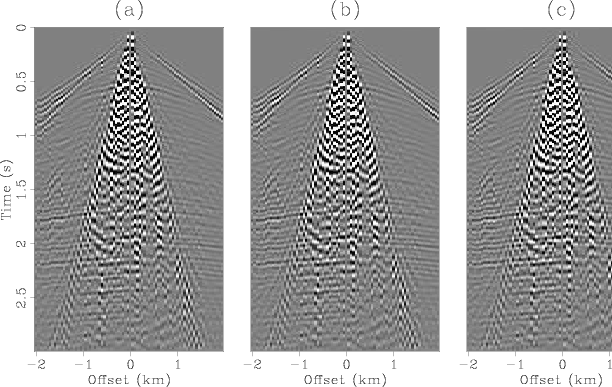
Figure 17. Estimate of ground-roll after one outer iteration (a), after 5 outer iterations (b) and after 10 outer iterations (c). Some of the body waves have been removed in panel (c) but much still remains. |
|
|
|
|
|
|
| |
|