


![[*]](http://sepwww.stanford.edu/latex2html/cross_ref_motif.gif) ). The contrast between the salt
body and sediment velocities cause the wavefield to exhibit
complicated propagation including significant wavefield triplication
and multipathing. The upper left panel shows the velocity model with
an overlain coordinate mesh generated by the differential method
discussed in Shragge (2006a). The mesh is a
ray-based coordinate system because the first and last extrapolation
steps are formed by the 0.04 s and 2.25 s travel-time isochrons from a
first-arrival Eikonal equation solution. The velocity model in
the GRWE domain is illustrated in the upper right panel.
). The contrast between the salt
body and sediment velocities cause the wavefield to exhibit
complicated propagation including significant wavefield triplication
and multipathing. The upper left panel shows the velocity model with
an overlain coordinate mesh generated by the differential method
discussed in Shragge (2006a). The mesh is a
ray-based coordinate system because the first and last extrapolation
steps are formed by the 0.04 s and 2.25 s travel-time isochrons from a
first-arrival Eikonal equation solution. The velocity model in
the GRWE domain is illustrated in the upper right panel.
The lower right panel shows the impulse response test in the GRWE domain. The 7 impulsive waves conform fairly well to the travel-time steps, except where they enter the salt body to the lower left of the image. The migration results mapped back to Cartesian space are shown in the lower left panel. The wavefield to the left of the shot point is fairly complicated and the energy in the salt body and the corresponding upward refracted (and perhaps reflected?) wavefields are strongly present.
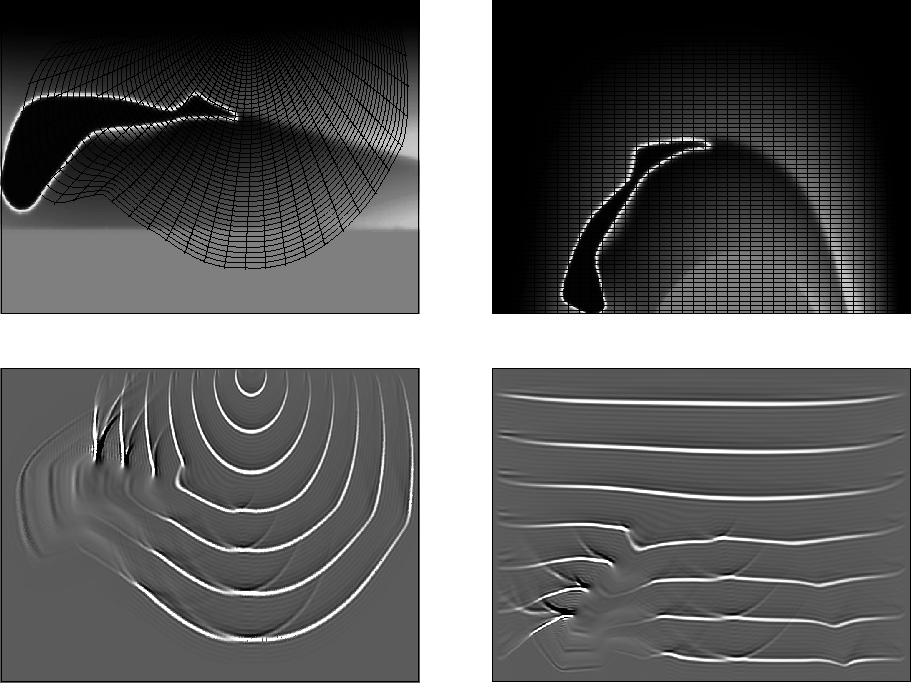 |


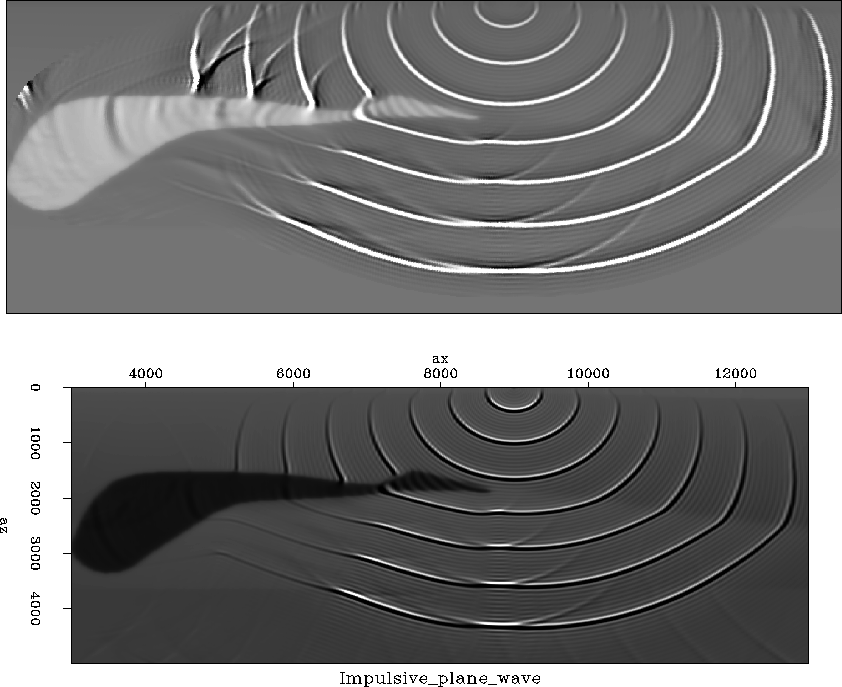
Figure presents a comparison test between GRWE and
Cartesian extrapolation. Beneath and to the right of the shot point
the wavefields are fairly similar except for a phase-change. However,
they are significantly different to the left because Cartesian-based
extrapolation cannot propagate energy laterally with the same accuracy
and upward at all. Hence, this energy is absent from the wavefield in
the lower panel.
 |