


To test RIP on a real 2-D example, we extracted a single line from the subset of the deep water Gulf of Mexico dataset. This line is located at the crossline position of 20 km, chosen in an attempt to minimize the 3-D effects of the salt structure. However, this line will still be affected by the 3-D faults known to run through this volume.
Recall that the regularization operator
used for geophysical RIP acts along the offset ray parameter axis.
The strength of regularization (see the fitting goals
(3)) for this real data example,
 , was chosen by trial and error. We have chosen to display
the results after 6 iterations
which was selected based on data space residuals, as
will be explained later. The result can be seen in Figure
, was chosen by trial and error. We have chosen to display
the results after 6 iterations
which was selected based on data space residuals, as
will be explained later. The result can be seen in Figure ![[*]](http://sepwww.stanford.edu/latex2html/cross_ref_motif.gif) .
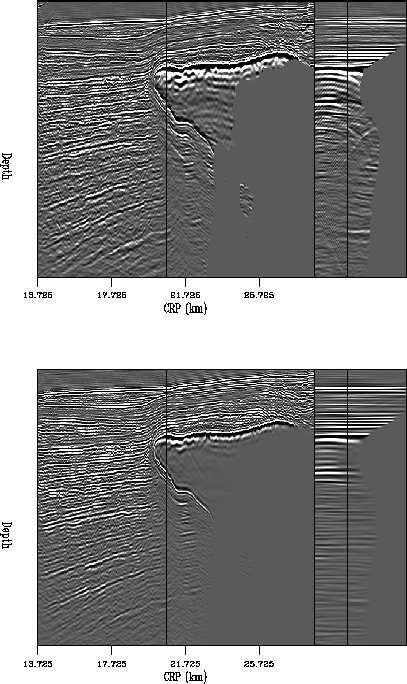
The migration result is
displayed above the geophysical RIP result. Both show a common ray parameter
section on the left and a common image gather (CIG) on the right. The vertical
lines indicate which common reflection point (CRP) location and offset ray
parameter value the panels are taken from. The effect
of the regularization is clearest in the CIG. The
common ray parameter section also shows the effects. The
result shows a crisper image after RIP, with fewer artifacts. To see the
improvements more clearly, we have zoomed in on the area beneath the salt in
Figure .
.
The migration result is
displayed above the geophysical RIP result. Both show a common ray parameter
section on the left and a common image gather (CIG) on the right. The vertical
lines indicate which common reflection point (CRP) location and offset ray
parameter value the panels are taken from. The effect
of the regularization is clearest in the CIG. The
common ray parameter section also shows the effects. The
result shows a crisper image after RIP, with fewer artifacts. To see the
improvements more clearly, we have zoomed in on the area beneath the salt in
Figure .
 |
 ,right part is a common image gather from
  .
Bottom: result of 6 iterations of
geophysical RIP.
.
Bottom: result of 6 iterations of
geophysical RIP.
![[*]](http://sepwww.stanford.edu/latex2html/movie.gif)


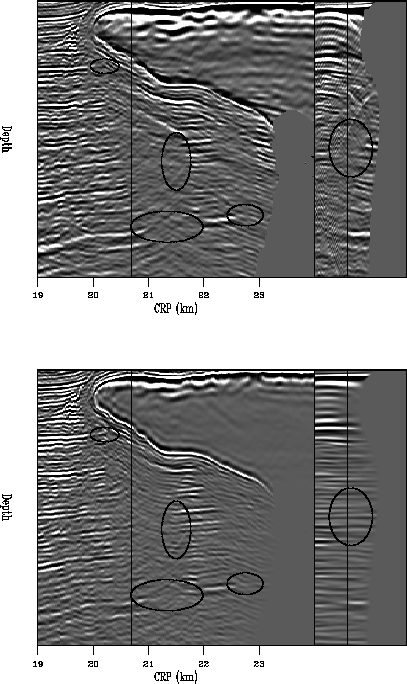
In Figure , the same ovals
are shown on the migration result (top) and the geophysical RIP result
(bottom). It is particularly clear that the holes in the common image
gather are being filled by RIP. The whole common
ray parameter section is cleaner than the one from the migration result. The
subsalt reflectors are extending into the shadow zones everywhere, particularly
in the areas indicated by the ovals. Geophysical RIP produces a cleaner
result with better illumination than migration.
 |
.
Top: result of downward-continuation migration
of 2-D line. Left part is a common offset ray parameter section at
,right part is a common image gather from .
Bottom: result of 6 iterations of geophysical RIP. Ovals indicate areas
where poor illumination exists in the migration result and is improved
in the RIP result.
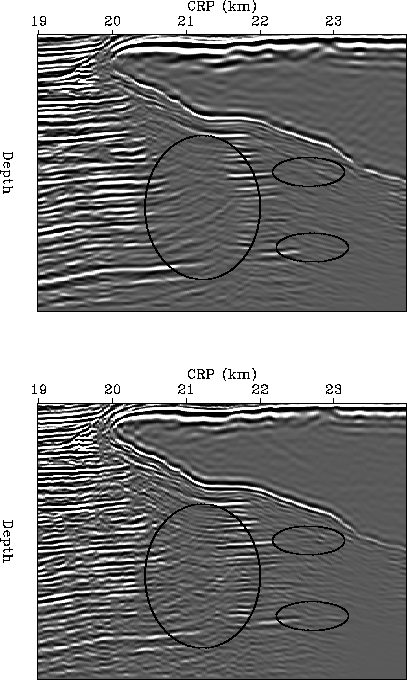
It is also interesting to stack
the results (Figure ).
Once again, the stack of the migration result is shown on top and the
stack of the result after 6 iterations of geophysical RIP is on the bottom.
The ovals indicate where the reflectors extend farther into the shadow
zones. In the RIP result, some reflectors can be seen almost all the way
through the poorly illuminated areas. Also, the artifacts
seen in the stack of the migration result are reduced in the RIP result.
 |
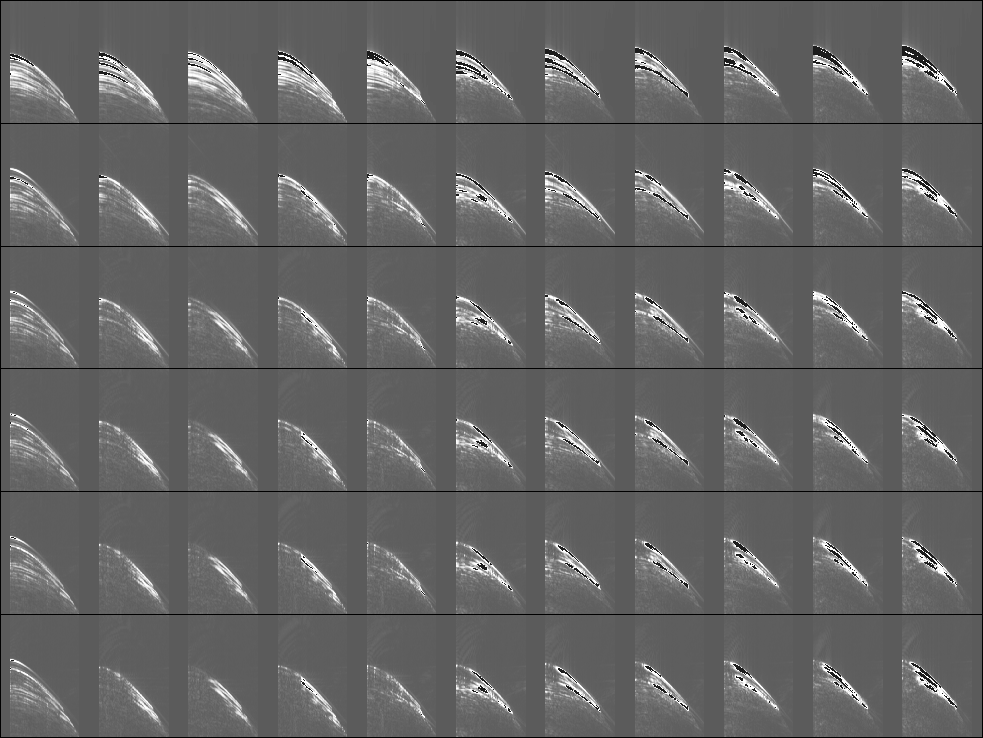
As mentioned earlier, we chose to display the RIP results after 6 iterations
based on an examination of the data space residuals as the least-squares
inversion was performed. The data space residuals for each iteration can be
seen in Figure . Each row is a collection of CMP gathers
taken from locations across the whole survey. We have taken the envelope of
the energy and clipped the high values, which appear as solid black regions.
The first row is the original
data, the second row shows the same CMP gathers after 2 iterations,
the third row is after 4 iterations, fourth row after 6 iterations,
fifth row after 8 iterations and sixth after 10 iterations. The
salt body begins at a CMP location between the fifth and sixth gathers
shown in each row.
The biggest change in the residual energy occurs within the first two iterations, as would be expected. We see that the residual energy away from the salt decreases quickly (the black areas decrease). The residual energy associated with the salt also decreases, with the exception of energy that is caused by converted waves that our acoustic code cannot properly handle. The small change in residual energy between the sixth and tenth iterations indicates that the inversion is nearing convergence. Therefore, we expect very little change in the image after 6 iterations.
 |