


The Mahogany field, located in the Gulf of Mexico, is dominated by a salt body structure. One of the data set acquired on this area consists on a 2-D Ocean Bottom Seismic (OBS) multicomponent line. Rosales and Guitton (2004) present the steps involved in the PZ summation that results in the P component section that is now under study. The PZ summation was successful in eliminating the receiver ghost; however, other surface-related multiples, like the source pegleg, are still present after the combination.
The remaining multiples are a problem when performing any migration-velocity-analysis
technique. Therefore, we apply the methodology discussed in the previous section to
eliminate the remaining multiples.
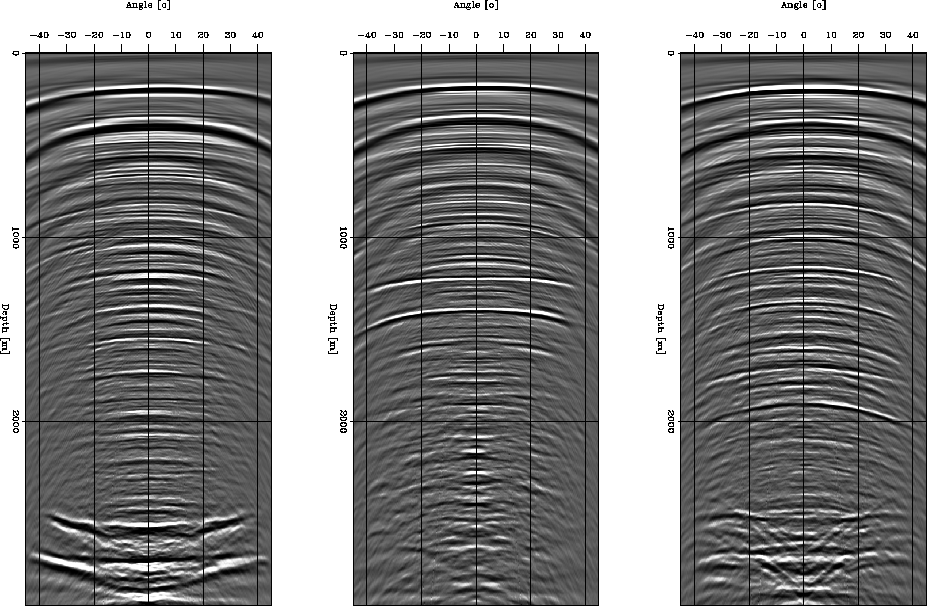
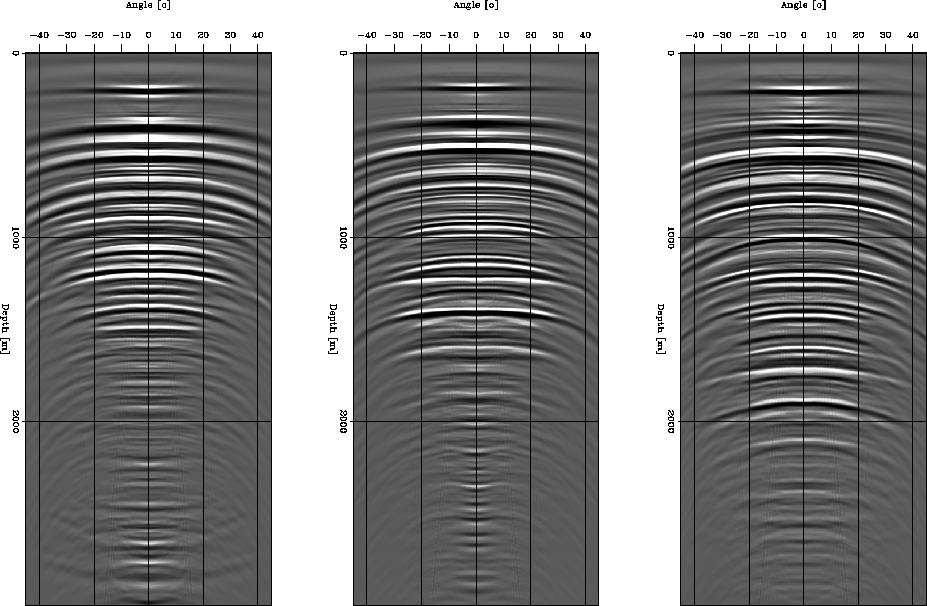
Figure ![[*]](http://sepwww.stanford.edu/latex2html/cross_ref_motif.gif) shows three characteristic angle-domain common-image gathers,
after three processes: the PZ summation described in Rosales and Guitton (2004), the downward continuation
of the sources to the receiver label, and the migration with the velocity model presented in
Rosales and Guitton (2004).
shows three characteristic angle-domain common-image gathers,
after three processes: the PZ summation described in Rosales and Guitton (2004), the downward continuation
of the sources to the receiver label, and the migration with the velocity model presented in
Rosales and Guitton (2004).
 |
![[*]](http://sepwww.stanford.edu/latex2html/movie.gif)


It is possible to observe a similar residual curvature for both primaries and multiples. Additionally,
at this stage the primaries and multiples present
a very similar moveout, since the migration velocity is still not perfect. Any migration-velocity-analysis
technique done with this data will be biased with the multiple reflections still present.
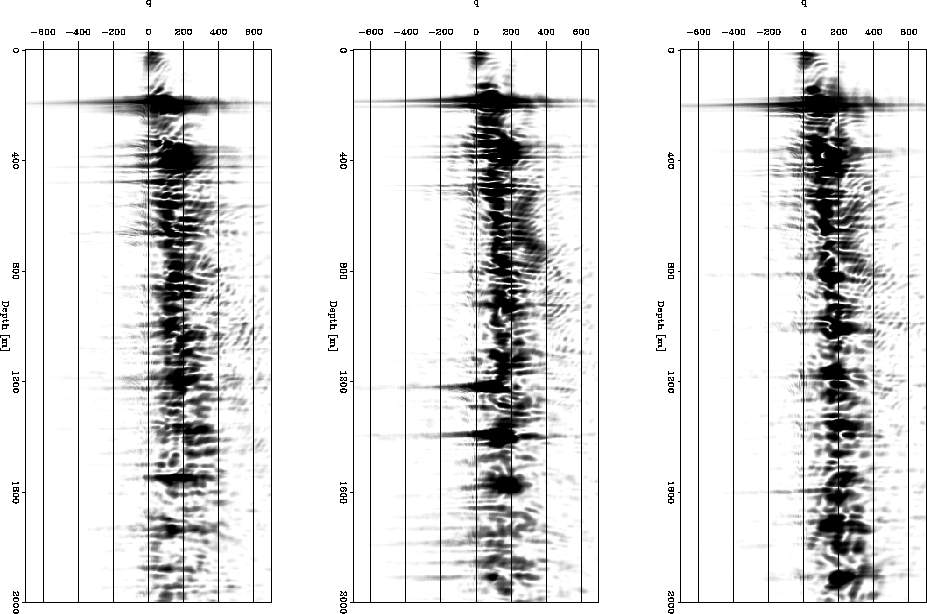
Additionally, Figure presents the same ADCIGs as in Figure
but after Radon transform in the angle domain is not easy to distinguish between primaries and multiples;
therefore, another process is required.
 |
A residual curvature process will help to separate primaries and multiples in the Radon domain.
The advantage of using residual migration (as discussed on the methodology) over residual moveout
is that residual migration reduces the effects of image-point dispersal between events imaged at the
same physical location but with different aperture angle Biondi (2004).
Performing SRM with a value of  different than 1 (e.g.,
  ) produces a distinct
difference between the residual moveouts of the
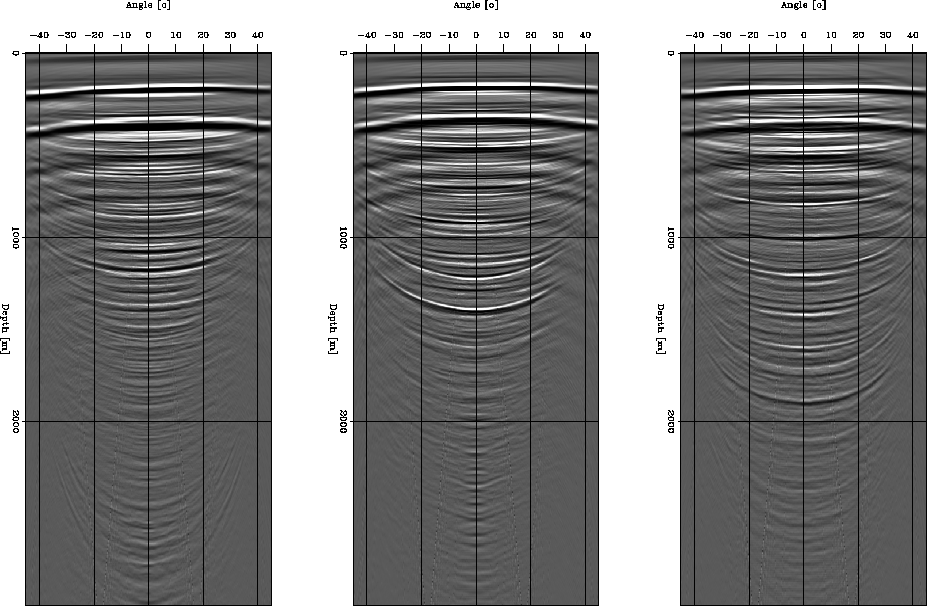
primaries and multiples. Figure shows the same ADCIGs as in Figure
after SRM with . It is now easy to distinguish between primaries and multiples through
their distinctive curvatures.
) produces a distinct
difference between the residual moveouts of the
primaries and multiples. Figure shows the same ADCIGs as in Figure
after SRM with . It is now easy to distinguish between primaries and multiples through
their distinctive curvatures.
 |
.
Applying the Radon transform splits the image into two different curvatures;
therefore, it is possible to distinguish between
primaries (positive curvature) and multiples (negative curvature); additionally, it is possible to apply
principles and techniques similar to those discussed by Sava and Guitton (2003) or
Alvarez et al. (2004).
Figure shows the ADCIGs in the Radon domain. After SRM is possible to
distinguish between primaries and multiples, compare the results on Figures
and .
Figure presents the result
after eliminating the multiples and applying SRM with a value of  ;
this result shows a satisfactory elimination of multiples.
;
this result shows a satisfactory elimination of multiples.
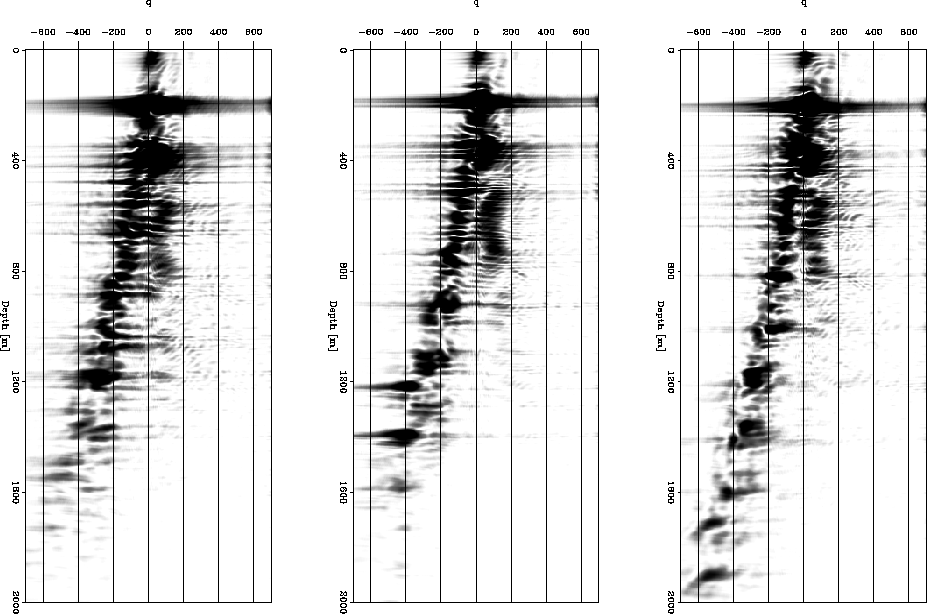 |
and note how multiples and primaries are split into
two different trends.
 |