


![[*]](http://sepwww.stanford.edu/latex2html/cross_ref_motif.gif) illustrates this property.
Two offset-domain image points are displayed.
points in the offset domain to the image point in the angle domain
along a direction orthogonal to the direction of the offset.
All the possible directions define a plane. The two orthogonal
planes are displayed on Figure .
The intersection of the two planes with the normal gives the position
of the image point in the angle domain.
More specifically, the energy moves at the
intersection between the orthogonal plane and the apparent propagation
plane.
To sum up,
when an incorrect migration velocity is used, the rays are not
coplanar.
There is however a preferential plane, the apparent propagation plane,
which allows one to cast the 3-D problem into a 2-D one.
illustrates this property.
Two offset-domain image points are displayed.
points in the offset domain to the image point in the angle domain
along a direction orthogonal to the direction of the offset.
All the possible directions define a plane. The two orthogonal
planes are displayed on Figure .
The intersection of the two planes with the normal gives the position
of the image point in the angle domain.
More specifically, the energy moves at the
intersection between the orthogonal plane and the apparent propagation
plane.
To sum up,
when an incorrect migration velocity is used, the rays are not
coplanar.
There is however a preferential plane, the apparent propagation plane,
which allows one to cast the 3-D problem into a 2-D one.
|
gamma_planes_2
Figure 6 Geometric construction of the image point in the angle domain from the image points in the offset domain. | 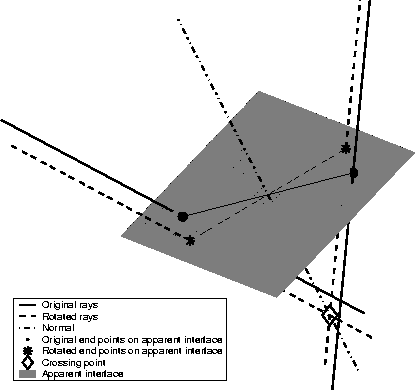 |


|
gamma_planes
Figure 7 Geometric construction of the image point in the angle domain from the source and receiver rays end points. | 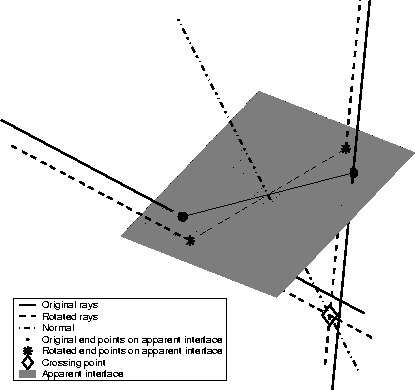 |