


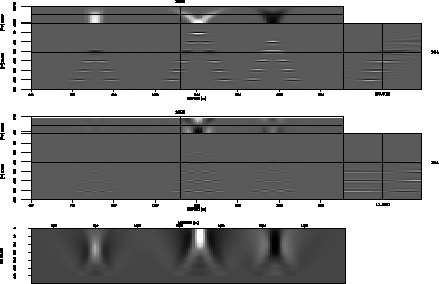
![[*]](http://sepwww.stanford.edu/latex2html/cross_ref_motif.gif) shows the optimal image
perturbation, found by subtracting the image obtained by prestack
depth migration with the constant (2000 m/s) background velocity from
that obtained with the correct velocity. While the absolute
values of the amplitudes in the FEAVO anomalies are stronger than the
background as expected, the polarities change every time the seismic wavelet
alternates sign. Vlad (2002) proposed an extraction approach that
would involve sweeping the image space with summations along the analytically computable shapes
of the FEAVO effects. To do that, we would have to use absolute or squared
values to prevent the polarity alternation from cancelling
the summed values. However, discarding the
information stored in the sign of the anomaly forfeits the
ability to distinguish between positive and negative velocity
anomalies.
shows the optimal image
perturbation, found by subtracting the image obtained by prestack
depth migration with the constant (2000 m/s) background velocity from
that obtained with the correct velocity. While the absolute
values of the amplitudes in the FEAVO anomalies are stronger than the
background as expected, the polarities change every time the seismic wavelet
alternates sign. Vlad (2002) proposed an extraction approach that
would involve sweeping the image space with summations along the analytically computable shapes
of the FEAVO effects. To do that, we would have to use absolute or squared
values to prevent the polarity alternation from cancelling
the summed values. However, discarding the
information stored in the sign of the anomaly forfeits the
ability to distinguish between positive and negative velocity
anomalies.
There are several ways of circumventing this problem. They can be simple and cheap, but case-specific (a priori knowledge whether the lenses are faster or slower than the background). They can be more general, but also more complex and expensive (do WEMVA iterations assuming a single sign until all anomalies of that sign are eliminated, allowing anomalies of the other sign to increase; then when only increases in the image perturbations are noticed, switch the sign and start again). Even with the polarity problem, more consideration will be given in the future to the focus-filter-spread approach as envisaged by Vlad (2002) because of its potential power of eliminating the non-FEAVO noise and of exploiting the entirety of the FEAVO morphological characteristics.
The polarity conundrum mentioned above can be
eliminated by identifying anomalies by their local, rather than
global, characteristics. The middle panel of Figure shows
the image perturbation for the TIF WEMVA obtained by eliminating the
DC component and by performing several other small adjustements
(correcting with a cosine of the angle factor for amplitude decay,
windowing away irrelevant energy at higher angles, etc). The
lower panel in Figure presents the velocity update
obtained after one WEMVA iteration. Additional iterations did not
change the result too much. The results may have improved had we used a
weighting operator to mask the unresolved anomalies at higher
angles (so they would not be fitted when inverting).
 |


