


The first group of parameters includes the size of the PEF; the shape of the PEF; the size of the gap; and in the case of non-stationary PEFs, the size and shape of the micropatches. The size of the PEF presents a trade-off between an improved ability to capture the inverse data covariance, and the number of fitting equations available to estimate the PEF. As the size of the PEF increases, the inverse data covariance is more accurately captured, but the number of fitting equations decreases.
The gap and center parameters both involve the shape of the PEF, and both have a nonintuitive effect on the result. They have a very light impact on the number of fitting equations, and a more pronounced effect on the ability of the PEF to capture the inverse covariance of the data.
The size and shape of the micropatches determine the non-stationarity of the filter. There is another trade-off here, where smaller micropatches allow for greater non-stationarity in the PEF, but also increase the size of the model space, i.e. the number of PEF coefficients.
This next set of parameters is used in the PEF estimation process. In the case
of a stationary PEF on regularly-sampled data, no extra parameters
are required for the regression except for the number of conjugate-gradient iterations.
However, once the data are sparse enough that a PEF cannot be estimated
in the traditional manner, rescaling of the data can provide more fitting equations.
The choice of these scales is present in the
 and
and  in fitting goals
(2) and (4).
in fitting goals
(2) and (4).
When estimating a non-stationary PEF, quite often the problem will be
under-determined; that is, that there will be more unknowns in model
space than fitting equations. This is overcome by adding a
regularization term to the optimization which introduces more
parameters, namely the choice of regularization ( in fitting
goal 3) and
in fitting
goal 3) and  . The choice of
regularization is data-dependent, but it normally operates over common filter coefficients
to insure a smoothly varying filter. In the case of common midpoint
gathers, the regularization is a radial roughener, since in a CMP
gather dips are approximately constant over radial lines
Crawley (2000). The choice of can be handled
by either balancing the model residual with the data residual, or by
balancing the size of the model and data gradients within the
conjugate-direction solver Claerbout (1999).
. The choice of
regularization is data-dependent, but it normally operates over common filter coefficients
to insure a smoothly varying filter. In the case of common midpoint
gathers, the regularization is a radial roughener, since in a CMP
gather dips are approximately constant over radial lines
Crawley (2000). The choice of can be handled
by either balancing the model residual with the data residual, or by
balancing the size of the model and data gradients within the
conjugate-direction solver Claerbout (1999).
Most of the parameters in this problem are independent. The
two exceptions to this are micropatch size and scale choice. Since
non-stationary filters are linked to data, if that data is regridded,
the non-stationary filter must also be regridded. So, the choice of
scales must maintain the aspect ratio of the data and also maintain
the spatial location of the micropatch boundaries, such that the same
filter coefficients are in the same place regardless of the scale.
This means that the choice of scale must cleanly divide all of the
data axes as well as all of the micropatch axes. Figure
![[*]](http://sepwww.stanford.edu/latex2html/cross_ref_motif.gif) has an illustration of both a valid and invalid
scales, given existing data and micropatch sizes.
has an illustration of both a valid and invalid
scales, given existing data and micropatch sizes.
|
nsscale
Figure 1 Plot of data space (grid) with the non-stationary PEF micropatches (overlay). Above: the rescaling doesn't cleanly re-sample the PEF, so the filter coefficients could be in different places depending on the scale. Below: The appropriate choice of scale maintains both the aspect ratio of the data and of the PEF. | 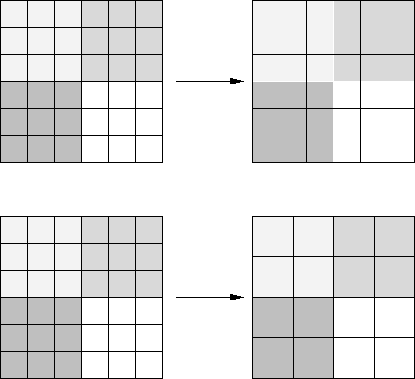 |

There is also a trade-off when optimizing micropatch size and scale choice. When the size of the micropatches is increased, the size of the model space decreases, and the number of possible scales increases. However, the PEF is then able to capture less non-stationarity in the data.
When choosing the micropatch and scale parameters, the goal is to have as many fitting equations as possible. In the non-stationary case, the need to have these fitting equations spatially distributed over a wide area is also important so that there are as few unconstrained micropatches (those with no fitting equations) as possible. In addition to varying scale and micropatch size, we can also vary the origin of the micropatch grid by shifting the positions of the micropatches so that they are more evenly constrained.