


![[*]](http://sepwww.stanford.edu/latex2html/cross_ref_motif.gif) -
illustrate the problem with HOCIGs
for a North Sea data set where the salt body has a vertical edge.
Because of presence of overturned paths,
the data were imaged using a shot-profile reverse time migration.
-
illustrate the problem with HOCIGs
for a North Sea data set where the salt body has a vertical edge.
Because of presence of overturned paths,
the data were imaged using a shot-profile reverse time migration.
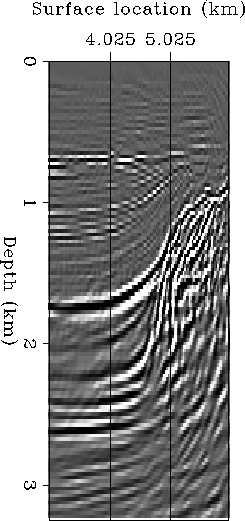
Figure
shows the image extracted at zero offset,
which is equivalent to the ``stacked image" for Kirchhoff-like
migration methods.
The vertical edge is well imaged at zero offset,
but when we analyze the image as a function
of offset at the fixed surface location corresponding
to the vertical salt edge
(right panel in Figure ),
we immediately notice that, at the depth interval
corresponding to the salt edge,
there is no focusing along the offset axis.
In contrast,
the focusing along offset is obvious
when we analyze the image
at the surface location corresponding
to mild reflector dips
(left panel in Figure ).
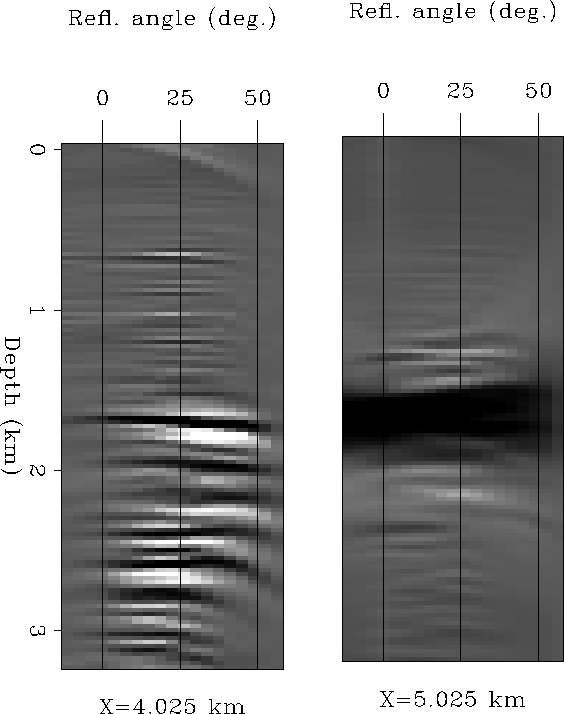
As expected, the lack of focusing
in the HOCIGs
carries over to the image after transformation to angle domain
by slant stacking
(Figure ).
In the next section we will explain
the degradation of the horizontal-offset CIGs
by a simple geometric analysis.
|
image-cig-new
Figure 1 Image of the North Sea data set. The black lines superimposed onto the image indicate the positions of the HOCIGs shown in Figure .
|  |

|
Cig-all-vz
Figure 2 HOCIGs extracted from the prestack image cube. Notice the blurring in the right panel at the depth of the salt edge. | 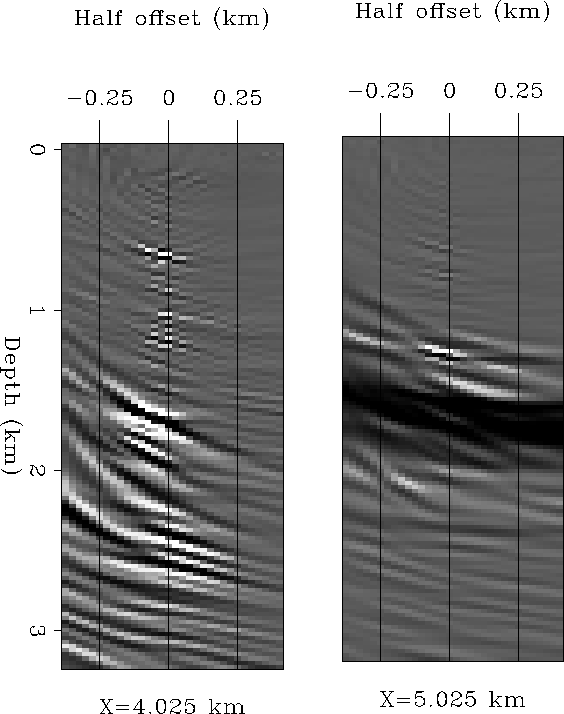 |
|
Ang-Cig-all-vz
Figure 3 Angle-domain CIGs corresponding to the HOCIGs shown in Figure .
Notice the blurring in the right panel
at the depth of the salt edge.
|  |
Figure
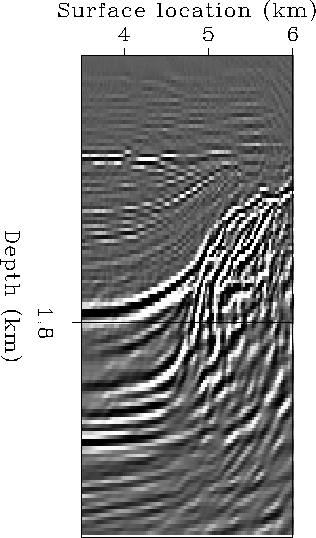
shows a vertical-offset CIG (VOCIG) for the same data set.
Since the offset is vertical, the image cube is
cut at a constant depth,
not at constant surface location.
The depth of this CIG corresponds to
the black line superimposed onto the image in
Figure .
Now the reflections from the salt edge are focused
around zero offset, while
the reflections from the flattish reflectors
are unfocused.
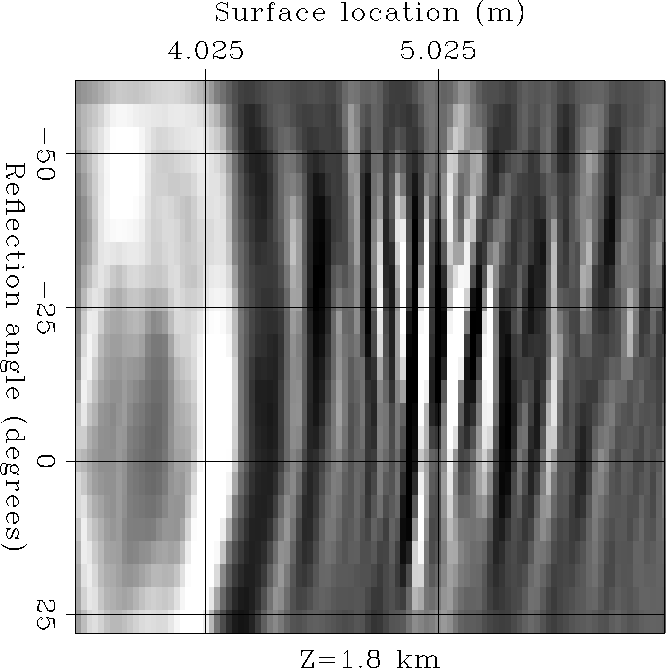
Similarly, after transformation to angle domain
(Figure )
the reflections from the salt edge show a slight moveout
that could be used to update the migration velocity function.
This task would be impossible if we had
to rely solely
on the information contained in the ADCIG obtained from HOCIG
(Figure ).
However, while the moveouts from the salt edge
are clearly interpretable in
(Figure ),
the moveouts from flat reflectors are not.
In summary, neither set of CIGs has readily available the information that is needed for velocity updating. In the next section we present a simple method to merge the HOCIG with the VOCIG, and produce a single set of CIGs that satisfies our requirements.
|
image-cig-hz-new
Figure 4 Image of the North Sea data set. The black line superimposed onto the image indicates the depth of the VOCIGs shown in Figure
|  |
|
Cig-1.8-vz-hz
Figure 5 VOCIG extracted from the prestack image cube. Notice the good focus at the horizontal location of the salt edge. | 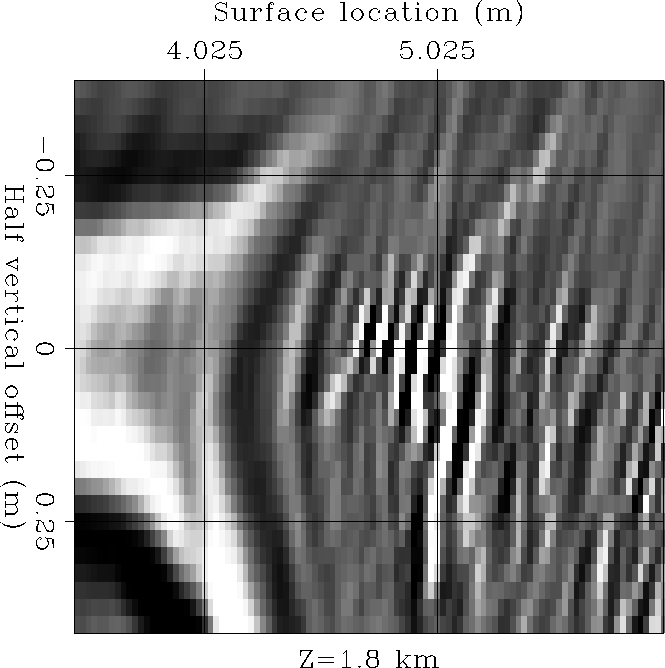 |
|
Ang-Cig-1.8-vz-hz
Figure 6 Angle-domain CIG corresponding to the VOCIGs shown in Figure .
Notice the slight moveout of the
the salt edge reflection.
|  |
 |