


A good comparison case can be provided by the
waveform modeling of deep FEAVO anomalies (Figure
![[*]](http://sepwww.stanford.edu/latex2html/cross_ref_motif.gif) ). Figure represents the results of
an equivalent experiment - propagating a shot (20Hz Ricker wavelet,
laterally smoothed a bit) from the surface to a line of receivers 6 km
deep. The difference is that in Figure the
propagation was done with linearized downward continuation [the
complexified local Born-Fourier method (), as
described by ()], instead of pseudospectral
waveform modeling. Details about the operator and the way the image
was constructed are in Appendix B. The FEAVO effects are easily
recognizable in amplitudes and the dispersion is missing. Even if they are less
powerful than in Figure , especially in time, they are clearly distinguishable.
). Figure represents the results of
an equivalent experiment - propagating a shot (20Hz Ricker wavelet,
laterally smoothed a bit) from the surface to a line of receivers 6 km
deep. The difference is that in Figure the
propagation was done with linearized downward continuation [the
complexified local Born-Fourier method (), as
described by ()], instead of pseudospectral
waveform modeling. Details about the operator and the way the image
was constructed are in Appendix B. The FEAVO effects are easily
recognizable in amplitudes and the dispersion is missing. Even if they are less
powerful than in Figure , especially in time, they are clearly distinguishable.
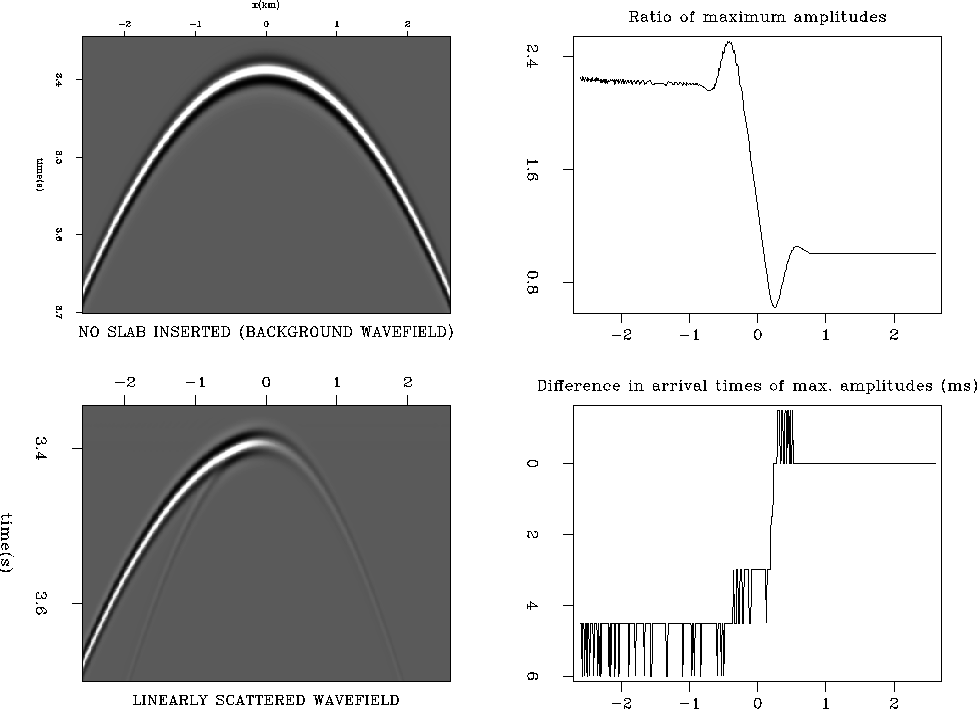 |
- and the background wavefield); Right, from
top to bottom: 3. Ratio between the maximum amplitudes in panel (1+2) and
panel 1, for each x location; 4. Difference between the times of the
maximum amplitudes in 1 and (1+2), for each x location. The wavefield was
propagated by linearized downward continuation (complexified local
Born-Fourier method) instead of pseudospectral waveform modeling.


