


The torsional mode of cylinder oscillation
(which is trivial for a simple cylinder, porous or not)
is determined here by a  system, of which 8 elements are in
general nonzero. This system is therefore similar in size and
difficulty to the cases studied earlier by Berryman (1983) for
extensional waves in a simple fully saturated poroelastic cylinder.
On the other hand, for extensional waves, the matrix determining the
extensional wave dispersion relation for patchy saturation
has 81 elements, of which 69 will
in general be nonzero. This problem requires sufficiently different
treatment from that for the torsional case that we set it aside to be
studied fully in a future publication.
system, of which 8 elements are in
general nonzero. This system is therefore similar in size and
difficulty to the cases studied earlier by Berryman (1983) for
extensional waves in a simple fully saturated poroelastic cylinder.
On the other hand, for extensional waves, the matrix determining the
extensional wave dispersion relation for patchy saturation
has 81 elements, of which 69 will
in general be nonzero. This problem requires sufficiently different
treatment from that for the torsional case that we set it aside to be
studied fully in a future publication.
|
concentric
Figure 1 Cross-section of a circular cylinder, where  is determined by the liquid saturation level S. is determined by the liquid saturation level S.
| 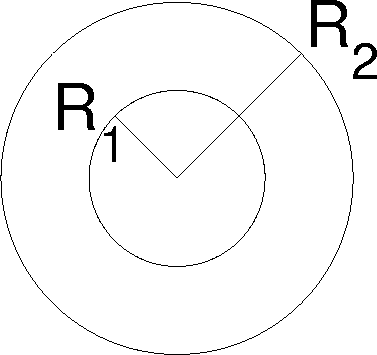 |

We assume that the cylinder has liquid saturation level S = (R1/R2)2, where R2 is the radius of the cylinder and r=R1 is the location of the liquid-gas interface (see Fig.1). The dispersion relation for torsional waves is then given by
 |
(228) |
Now we notice immediately that there could be two elementary solutions
of (detT), one with m11*(R2) = n11*(R2) = 0
(exterior condition)
and another with m11(R1) = m21(R1) = 0
(interior condition). First, the interior condition is satisfied, for
example, when ksr = 0 or, equivalently, when kz2 = ks2. This
corresponds to a torsional mode of propagation having wave speed and
attenuation determined exactly by the bulk shear wave in the interior
region, but the interior region is not moving since ksr=0 also
implies that  from (utheta). Thus, the
interior condition results in the drained outer shell twisting around
a stationary inner liquid-saturated cylinder.
Second, the exterior condition is similarly satisfied when ksr* = 0
or, equivalently, when kz2 = (ks*)2. This condition looks
at first glance as if it might be spurious because ksr* = 0 suggests
that
from (utheta). Thus, the
interior condition results in the drained outer shell twisting around
a stationary inner liquid-saturated cylinder.
Second, the exterior condition is similarly satisfied when ksr* = 0
or, equivalently, when kz2 = (ks*)2. This condition looks
at first glance as if it might be spurious because ksr* = 0 suggests
that  at the exterior boundary might vanish identically, and
then this would correspond to a trivial solution of the equations.
However, looking closer, this is not the case, because at the external boundary
at the exterior boundary might vanish identically, and
then this would correspond to a trivial solution of the equations.
However, looking closer, this is not the case, because at the external boundary
![\begin{displaymath}
u_\theta = k_{sr}^*\left[J_1(j_s^*)\gamma_s^* + Y_1(j_s^*)\epsilon_s^*\right],
\end{displaymath}](img492.gif) |
(229) |
 , the first term on the right hand side of
(exterior) does vanish, both because and also because
, the first term on the right hand side of
(exterior) does vanish, both because and also because
 .But the second term does not vanish in this limit because
 as ,and the product gives the finite result:
  . So this condition
is not spurious, and corresponds to a torsional wave propagating with
the speed and attenuation of the bulk shear wave speed in the drained
shell material.
. So this condition
is not spurious, and corresponds to a torsional wave propagating with
the speed and attenuation of the bulk shear wave speed in the drained
shell material.
Can both of these elementary modes be excited? If we assume for the
moment that Gassmann's equations (1951) [also see Berryman
(1999)] apply to the sample,
then  and the only changes in shear wave velocity in the
two regions are those induced by the changes in mass. In this
situation,
the wave speed in the air/gas saturated region will be faster than that in
the water/liquid saturated region, since liquid is more dense than
gas.
Thus, the real part of ks* is smaller than that of ks, and
while the condition (ksr*)2 = 0 implies that the real part of
ksr2 is positive, the condition ksr2 = 0 implies that
the real part of (ksr*)2 is negative. Therefore, assuming (as we
generally do here) that the attenuation in the system is relatively
small, the condition kz = ks* leads to a propagating wave, while
kz = ks leads to a strongly evanescent wave.
Note that, if Gassmann's results do not apply to the system (say at
ultrasonic frequencies), then the results
of the preceeding paragraph may need to be reconsidered. In
particular, if the shear modulus changes rapidly with the
introduction of liquid saturant, it is possible that the shear wave
speed for a liquid saturated porous material may be higher than that for
the gas saturated case. In this situation, all the inequalities of the
preceding paragraph would be reversed, and then the condition kz = ks
leads to a propagating wave, while kz = ks* leads to a strongly
evanescent wave.
and the only changes in shear wave velocity in the
two regions are those induced by the changes in mass. In this
situation,
the wave speed in the air/gas saturated region will be faster than that in
the water/liquid saturated region, since liquid is more dense than
gas.
Thus, the real part of ks* is smaller than that of ks, and
while the condition (ksr*)2 = 0 implies that the real part of
ksr2 is positive, the condition ksr2 = 0 implies that
the real part of (ksr*)2 is negative. Therefore, assuming (as we
generally do here) that the attenuation in the system is relatively
small, the condition kz = ks* leads to a propagating wave, while
kz = ks leads to a strongly evanescent wave.
Note that, if Gassmann's results do not apply to the system (say at
ultrasonic frequencies), then the results
of the preceeding paragraph may need to be reconsidered. In
particular, if the shear modulus changes rapidly with the
introduction of liquid saturant, it is possible that the shear wave
speed for a liquid saturated porous material may be higher than that for
the gas saturated case. In this situation, all the inequalities of the
preceding paragraph would be reversed, and then the condition kz = ks
leads to a propagating wave, while kz = ks* leads to a strongly
evanescent wave.
Our conclusion then is that both modes can indeed be excited, but probably not simultaneously in the same system in the same frequency band. In a highly dispersive porous system and with broadband acoustic signal input, it could happen that both modes are propagating simultaneously in time, but in distinct/disjoint frequency bands.