


 |

The data presented here on Schuler-Cotton Valley sandstone are
from Murphy (1982). Walls (1982) also studied permeability variations
of other samples from the same formation, but both of his samples had higher
porosity than the one studied by Murphy ( ). Murphy's
compressional wave measurements were made at about 200 kHz and the
shear measurements at about 150 kHz. The fitting parameters chosen for this
sample were Km = 41.8 GPa,
). Murphy's
compressional wave measurements were made at about 200 kHz and the
shear measurements at about 150 kHz. The fitting parameters chosen for this
sample were Km = 41.8 GPa,  GPa, and
  . Otherwise the analysis was identical to that for Sierra White granite.
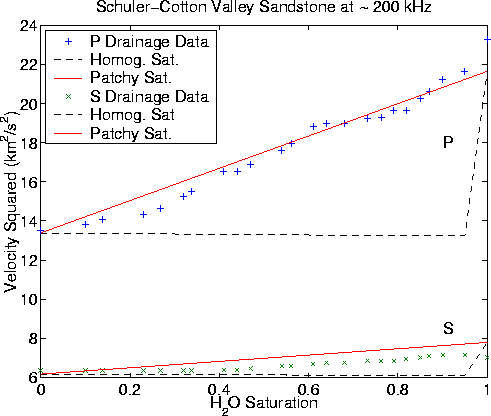
Results are shown in Figure 3. These curves are similar to those
for the granite since the compressional wave data show a
very clear trend along the patchy saturation line. The shear wave
data were harder to fit for this case, since the change in shear wave
speed does not mimic that of the compressional wave as one might expect.
For the Sierra White granite, a single value of
. Otherwise the analysis was identical to that for Sierra White granite.
Results are shown in Figure 3. These curves are similar to those
for the granite since the compressional wave data show a
very clear trend along the patchy saturation line. The shear wave
data were harder to fit for this case, since the change in shear wave
speed does not mimic that of the compressional wave as one might expect.
For the Sierra White granite, a single value of  was
sufficient to bring both P- and S-wave speeds into good
agreement with the theoretical curves. Here, this was not possible,
as the variation in compressional wave speed is substantially greater
than that for the shear wave speed. A possible conclusion from
this observed behavior is that the cracks that dominate compressional
wave speed changes are not the same as those for the shear wave speed
changes in this rock. But if this is true, it is not clear how
to go about modeling such an effect.
was
sufficient to bring both P- and S-wave speeds into good
agreement with the theoretical curves. Here, this was not possible,
as the variation in compressional wave speed is substantially greater
than that for the shear wave speed. A possible conclusion from
this observed behavior is that the cracks that dominate compressional
wave speed changes are not the same as those for the shear wave speed
changes in this rock. But if this is true, it is not clear how
to go about modeling such an effect.