


![[*]](http://sepwww.stanford.edu/latex2html/cross_ref_motif.gif) . The previous results generated by
autocorrelation processing () used a
low-cut version of the data that removes the energy below 2 mHz.
. The previous results generated by
autocorrelation processing () used a
low-cut version of the data that removes the energy below 2 mHz.
|
spec
Figure 1 Frequency content of the passive solar seismic data set. Data are sampled in Kilo-seconds yielding milli-Hertz frequencies. | 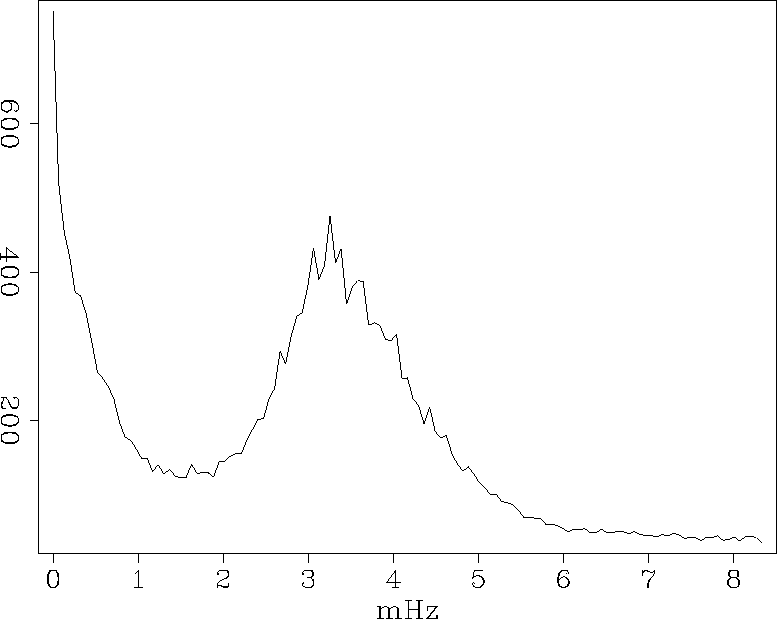 |


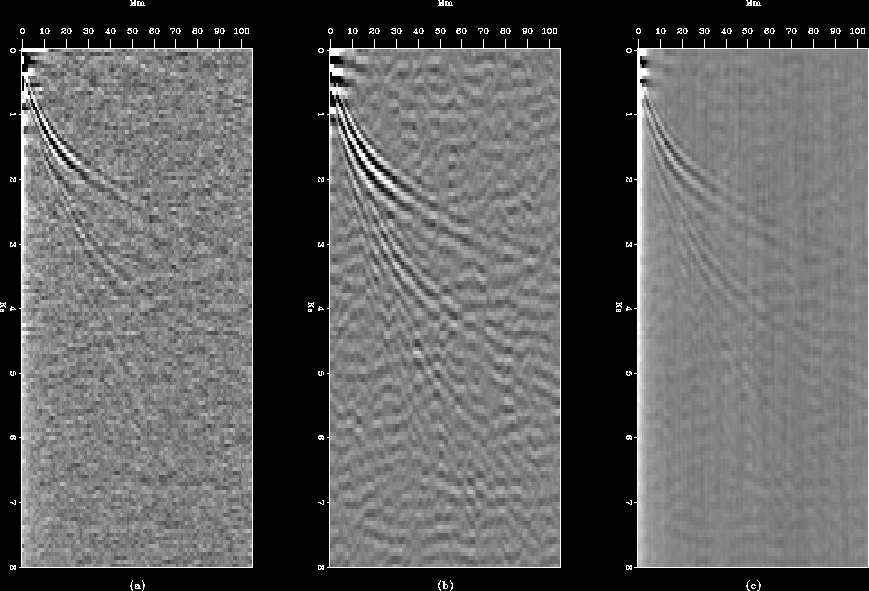
Figure is a comparison of three different inputs to
the autocorrelation processing algorithm. The right panel uses the
raw data. The center panel uses a low-cut version of the data. The
left panel is the output after 1-dimensional deconvolution.
Unfortunately, a
small amount of DC noise has survived the deconvolution process.
Because the solar data is not quite as stationary as had been hoped,
estimating the PEF on too small an area resulted in an output
spectrum that is not white in all locations. Some color
left in the frequency content of the result would seem acceptable;
however, the low-frequency contribution to the result presents a
problem in the auto-correlation processing.
 |
To better combat this near-D.C. component of the data, all of the
traces were passed through a 1D gradient operator. Having thus
removed the low-frequency component of the data, the PEF estimation
and convolution process was performed again followed by
auto-correlation processing. Figure shows the
result of this processing scheme. The result is better focused,
crisper and more pleasing than the results shown in
() generated by low-cut filtering and
auto-correlation processing.
|
newevent
Figure 3 After 1D gradient, deconvolution, and auto-correlation processing the solar passive seismic data may reveal faint new events on this in-line section. Look carefully for 3 dark linear events: from (0Mm,0ks), (10Mm,0ks), and (40Mm,0Ks). The velocity of these events is approximately 50,000 m/s. | 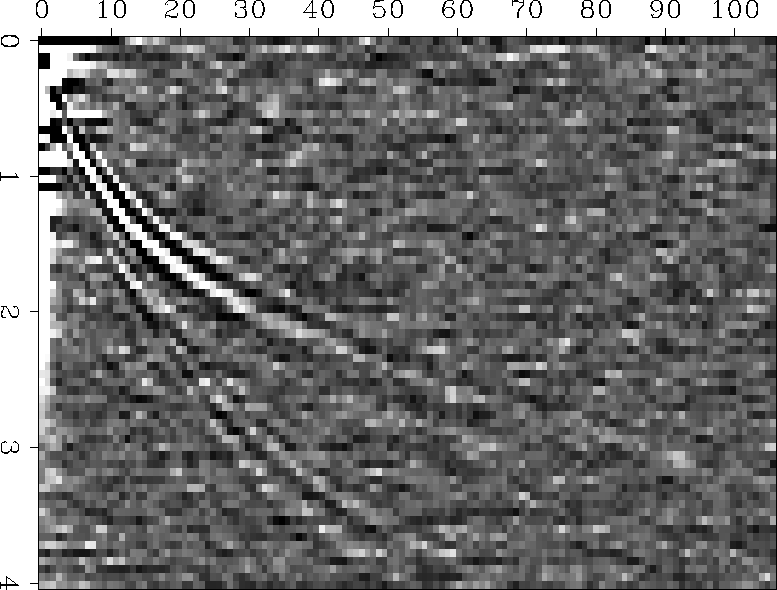 |
The first in-line section of the result of this processing chain is
shown in Figure and seems to show three faint
events that have not been previously identified. Unfortunately,
further evidence to corroborate them as real events have not been
fruitful. Perpendicular sections do not reveal similar events. Time
slices do not show circular horizon intersections. Finally, an
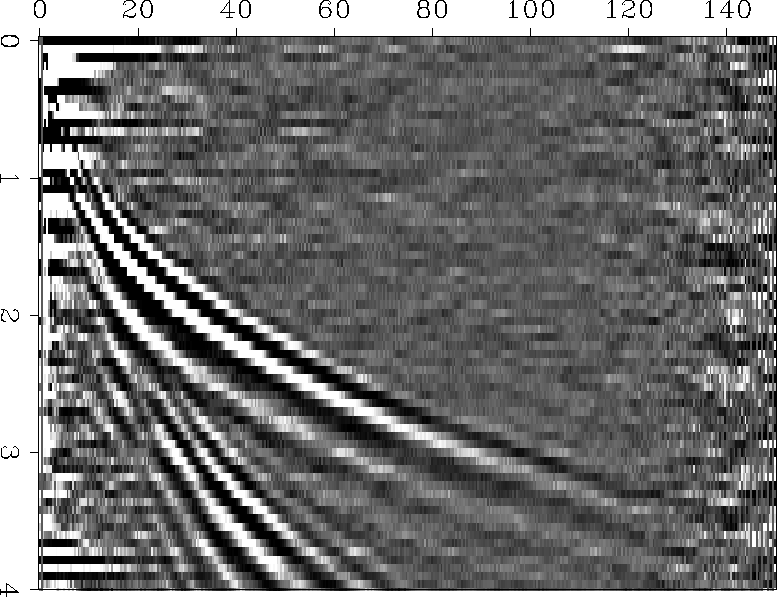
azimuthal stack around the central trace was calculated. Figure
shows this result with no indication of the earlier
events.
 |