


 |

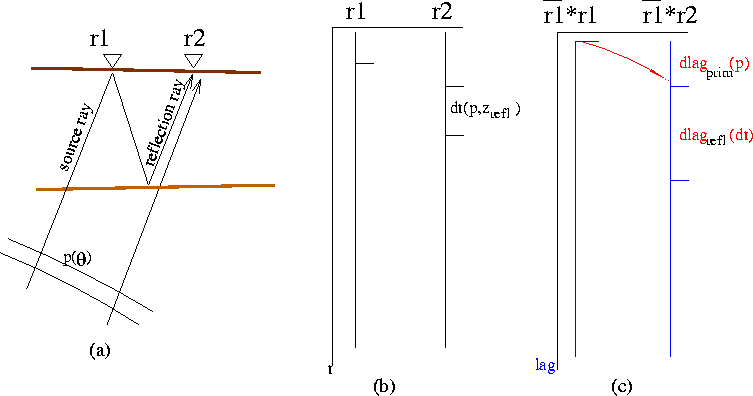
The cartoon in Figure ![[*]](http://sepwww.stanford.edu/latex2html/cross_ref_motif.gif) shows schematically how an
upcoming wave-train,
shows schematically how an
upcoming wave-train,  , will reflect from the surface and
act as a source at receiver r1 for the subsurface reflection
recorded at r2. An intuitive understanding of this experiment
and the manufacture of pseudo shot gathers can be developed by
progressing through the panels of Figure from the
earth model in panel (a) through the raw data recording in panel (b)
to the correlated records in panel (c) where the fast-axis is now in
units of correlation lag.
, will reflect from the surface and
act as a source at receiver r1 for the subsurface reflection
recorded at r2. An intuitive understanding of this experiment
and the manufacture of pseudo shot gathers can be developed by
progressing through the panels of Figure from the
earth model in panel (a) through the raw data recording in panel (b)
to the correlated records in panel (c) where the fast-axis is now in
units of correlation lag.
The correlation step has two important functions when applied to raw
passive data. First, it collapses to an impulse the long
source functions of the ambient sound energy recorded at each
station. Second, it develops hyperbolic move-out of these impulses as
a single input trace is correlated with data from stations at
increasing offset. Figure shows a representative
gather from a synthetic passive dataset over a two-layer earth-model.
|
shot
Figure 2 Representative pseudo shot gather from data cube generated by cross-correlating all traces from a modeled passive seismic dataset. The raw data trace that has been correlated with all the others serves as the source location for the gather. Notice the ``virtual multiple'' at 0.11 seconds. This arises due to the partial correlation of the two reflectors between themselves. The greater the velocity contrast, the less visible this event. Its zero-offset time is equal to the difference in time between the two events. | 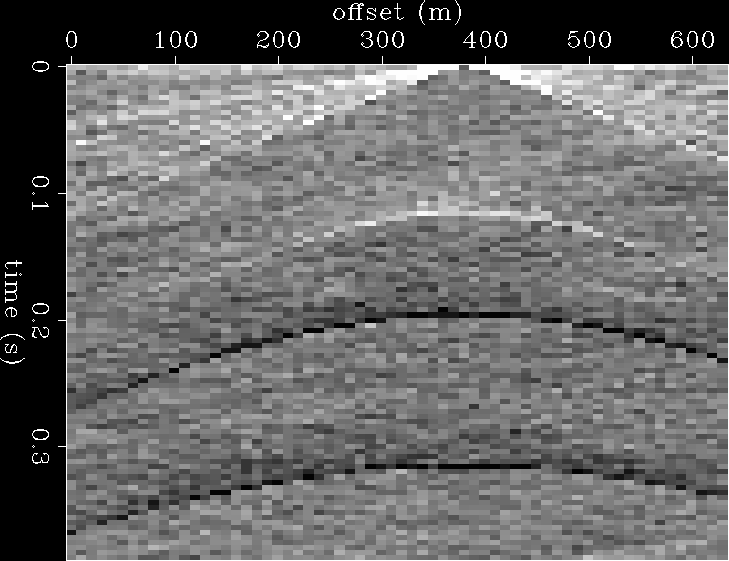 |


After the pseudo shot gathers are constructed through correlation, a conventional five-dimensional data volume is ready for any common processing flow such as sorting and migration. However, I show that it is possible to migrate the raw data directly with a shot-profile migration algorithm that has been modified to use an areal source rather than a conventional impulse or wavelet. I present comparisons of both methods performed on modeled data and comment on some of their characteristics and costs.