


![[pdf]](icons/pdf.png)
|
|
|
|
| Single frequency 2D acoustic full waveform inversion | |
|
An approximate physical model for a single mode of surface waves is waves travelling in two dimensions given a phase velocity map,
 . The amplitudes and phases of surface waves, in that approximation, are governed by
 and
and
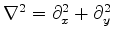 . Equation 1 is very similar to a classical 2D acoustic wave equation, except that the velocity is now a function of frequency. Explicitly solving for a single frequency renders this difference moot. However, frequency domain solutions are slow to compute, and implementation of absorbing boundary conditions is not straightforward. Here we solve equation 1 by a time-domain equivalent, valid for individual frequencies and independent of boundary condition.
We want to use equation 1 to image the phase-velocity cube
 by full waveform inversion (FWI) for each frequency separately. But single frequency data generally does not resolve anomalies in space, because sensitivity kernels have endless oscillatory behaviour. Conventionally, summing over a finite frequency band collapses the sensitivity kernels to the classic and familiar banana-doughnut kernels (Dahlen and Nolet, 2000). However, in this paper we show that a similar effect is achieved by having sources and receivers throughout and around the target of interest.
This paper starts by connecting a time domain kernel to solutions of the 2D frequency domain acoustic kernels with frequency dependant velocity. Then a non-linear optimization algorithm is developed to invert single frequency amplitude and phase data. Finally we explore the ability of various acquisition grids to invert for a Gaussian anomaly.
|
|
|
|
| Single frequency 2D acoustic full waveform inversion | |
|
