![[pdf]](icons/pdf.png)
|
|
|
|
| P/S separation of OBS data by inversion in a homogeneous medium | |
|
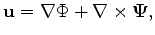
The Helmholtz separation operator is based on the assumption that any isotropic vector field can be described as a combination of a scalar and vector potential fields:
 is the scalar potential field and
 is the vector potential.
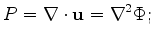
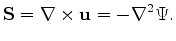
  is the elastic displacement vector wavefield. The scalar potential generates pressure waves, and the vector potential generates shear waves. Therefore, the Helmholtz method of separating the P-wave amplitude from the S-wave amplitude is to apply a divergence operator and a curl operator to the displacement field:
Equations 3 and 4 apply only for an isotropic medium. Dellinger and Etgen (1990) extend these operators for an anisotropic medium.
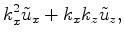
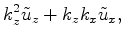
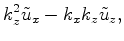
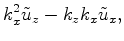
The Helmholtz separation operator is useful for distinguishing between P and S-wave amplitudes, but it is not reversible. The derivation of a reversible P-wave and S-wave displacement decomposition by Zhang and McMechan (2010) is done in the wavenumber domain. They formulate a linear equation system based on characteristics of P and S particle displacements in an isotropic elastic medium. The solutions to this linear system in a two-dimensional medium are:
and
where
 are the spatial fourier transforms of the observed displacement fields in direction
  ,
,  are the wavenumbers, and
 and
and
 are the decomposed P and S displacements. It is important to note that the
  in these equations is normalized by the absolute value of the wavenumber
 . This decomposition is reversible, since
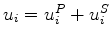 .
.
|
|
|
|
| P/S separation of OBS data by inversion in a homogeneous medium | |
|