


![[pdf]](icons/pdf.png)
|
|
|
|
| Preconditioned least-squares reverse-time migration using random phase encoding | |
|
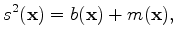 is the slowness,
  is the background model, which is a smooth version of the slowness squared,
  is the model, and
  is the model coordinate. Then, the Green's functions that satisfy the acoustic wave equation using the background model are defined as follows:
 is the Green's function,
 and
and
 are the source and receiver coordinates, and
  is frequency. The forward modeling operator is defined using the Green's functions as follows:
 is the surface data and
  is the source function. The forward modeling operator
  can be written in matrix form as follows:
 as:
as:
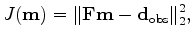 is the observed surface data. The quadratic objective function
can be minimized iteratively using the following scheme (Claerbout and Fomel, 2011):
is the observed surface data. The quadratic objective function
can be minimized iteratively using the following scheme (Claerbout and Fomel, 2011):
The
iterate {
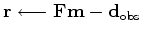


}
 indicates the adjoint operator. The cost of each iteration equals the cost of the forward and adjoint operators. The stepper function is either steepest-descent or conjugate gradient.
There are several encoding functions that can be used in LSRTM (Godwin and Sava, 2011; Perrone and Sava, 2009). However, a single-sample random phase function gives the best convergence results (Romero et al., 2000; Krebs et al., 2009). This encoding function results in crosstalk artifacts in the estimated models. These artifacts are reduced by averaging several realizations of the encoding function. The source-side encoding function  is defined as follows (Tang, 2009):
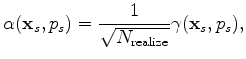 is the realization index,
 is the number of realizations, and
  is a random sequence of signs (i.e. +1 and -1). The encoding function is used to blend the observed data as follows:
 is the blended source wavefield. Due to the linearity of the wave equation, this wavefield can be simply computed by simultaneously injecting the source functions at different locations after multiplying by the proper weight. Once
is computed, the blended forward modeling operator can defined as follows:
is the blended source wavefield. Due to the linearity of the wave equation, this wavefield can be simply computed by simultaneously injecting the source functions at different locations after multiplying by the proper weight. Once
is computed, the blended forward modeling operator can defined as follows:
 is used to indicate blending. The blended forward modeling operator
 can also be expressed in matrix form:
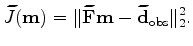
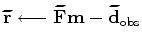
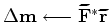
iterate {

}
There are two changes in the minimization scheme of the blended objective function compared to the conventional one. First, the computation of the residual is moved inside the loop, because the encoding function changes in each iteration. This change adds the cost of a forward modeling operator to each iteration. Second, the stepper algorithm can only be steepest-descent if the step size is determined with linear optimization. Otherwise, a non-linear conjugate gradient can be performed, requiring a line search in each iteration. In this paper I present only the result of using steepest-descent stepper, because the iteration cost is consistent.
|
|
|
|
| Preconditioned least-squares reverse-time migration using random phase encoding | |
|








