![[pdf]](icons/pdf.png)
|
|
|
|
| Moveout-based wave-equation migration velocity analysis | |
|
 for a fixed
 is
, if the image
is
, if the image
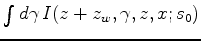
 and the angle-averaged image
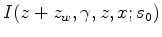 become out of phase, the derivative of eq. (5) will point to the wrong shift direction.
To prevent cycle-skipping, we need a way to detect the global shape of the ADCIGs. Almomin (2011) propose to measure the relative shift the traces at each angle with respect to some reference trace by picking cross-correlation peak. Here we use the residual moveout (RMO) parameters so that the objective function knows whether the angle gather is curving up or curving down.
As shown in Biondi (2003) Chap 11, in the case of constant velocity error, the residual moveout of an ADCIG gather is
where
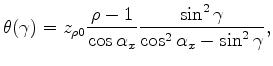 and
and  are the dip angle and reflection angle respectively, and
  is the true reflector depth,
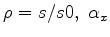 .
If we assume the dip is small, then the expression above can be further simplified to
.
If we assume the dip is small, then the expression above can be further simplified to

Therefore we introduce the moveout parameter
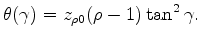 and the moveout function
 . The objective function we want to maximize
is the angle stack-power of the inital image after applying the residual moveout:
. The objective function we want to maximize
is the angle stack-power of the inital image after applying the residual moveout:
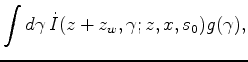
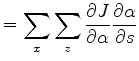
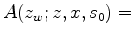
The derivative is
Define
 |
 |
||
 |
 |
 relation (see appendix B):
 to
to
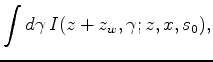
 by defining an auxilary objective function; we call this the direct operator.
to the shift parameter
perturbation at each angle, through a weighted least-squares fitting formula; thus
 ; and as shown previously, we know how to calculate
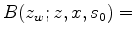
 . We call this the indirect operator.
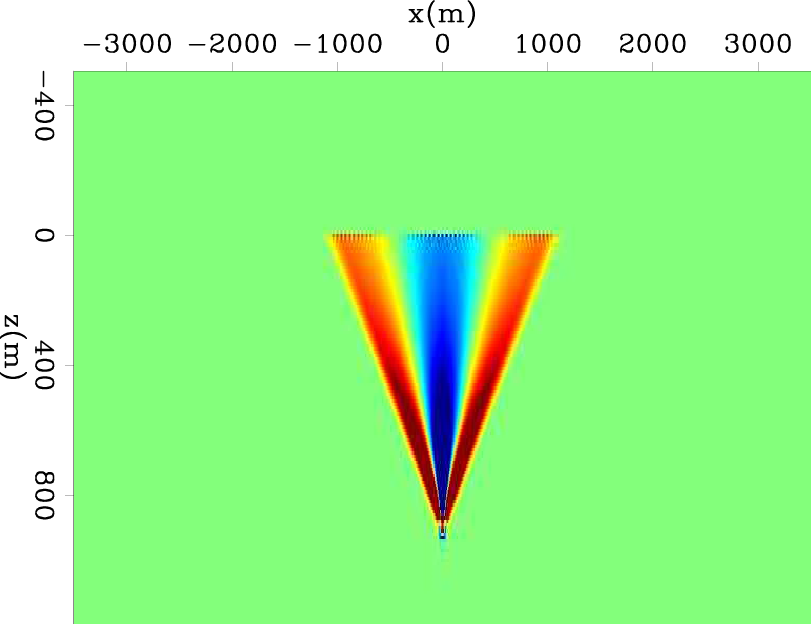
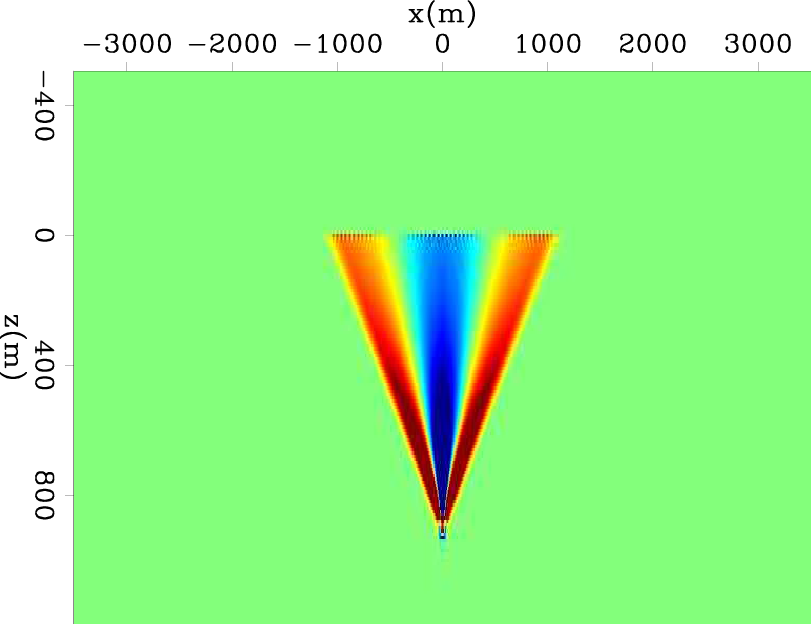
The sensitivity kernel
calculated using the direct operator and the indirect operator
are shown in figure 2, as with the Toldi operator (Toldi, 1985), the characteristic shape of
such a sensitivity kernel is a center lobe, with two side lobes with oppositite polarity, which reaffirms the well known fact
that velocity perturbation at the center and the side-end lateral position will change the curvature of ADCIGs towoard opposite directions.
Yet the overall average is positive, which would give the correct update in case of a bulk shift slowness error.
|
|---|
|
sensKer1w.bf2,sensKer1w.bf1m
Figure 2. Sensitivity kernel  calulated using the direct operator (a)
and the indirect operator (b), using constant background velocity and a flat reflector.
calulated using the direct operator (a)
and the indirect operator (b), using constant background velocity and a flat reflector.
|
|
|
Now if we review this method on eq. (6), the success of this method simply relies on the proper behavior of
the two components in eq. (6):
 needs to correctly detect the curvature of the ADCIGs so that the inversion will choose a moveout direction that properly flatten the gathers;
needs to properly convert the curvature perturbation to the update in slowness space.
needs to correctly detect the curvature of the ADCIGs so that the inversion will choose a moveout direction that properly flatten the gathers;
needs to properly convert the curvature perturbation to the update in slowness space.
In cases where velocity error is big, the actual curvature of the gather may be poorly
represented the
term. To further improve the robustness and precondition the gradient, the
analytic expression of
in eq. (6) is replaced by a numerical approach. First a semblance
panel of  will be calculated. To ensure that the derivative at
  can determine the correct curvature
that maximizes the semblance value, a Gaussian derivative rather than a simple
can determine the correct curvature
that maximizes the semblance value, a Gaussian derivative rather than a simple  finite-difference derivative is applied. The width of the Gaussian can be reduced in later iterations.
|
|
|
|
| Moveout-based wave-equation migration velocity analysis | |
|
![$\displaystyle \bold J(s) = \frac{1}{2} \sum_{x}\sum_{z} \int dz_w {\left[ \int d\gamma \, I(z+z_w+b,\gamma,z,x;s_0) \right]}^2 .$](img41.png)
![$\displaystyle \frac{\partial{J}}{\partial{b(\gamma,z,x)}}\vert _{b=0} = \frac{1...
...gamma \, I(z+z_w,\gamma,z,x;s_0) \right] \dot{I}(z+z_w,\gamma,z,x;s_0) \Big\} .$](img43.png)
![$\displaystyle \bold J = \frac{1}{2} \sum_{x}\sum_{z} \int dz_w {\left[ \int d\gamma \,
I(z+z_w+\alpha g(\gamma),\gamma,z,x;s_0) \right]} ^2 .
$](img52.png)
![$\displaystyle \frac{\partial J}{\partial s} \vert _{s=s_0} =
\sum_{x}\sum_{z} ...
...mma,z,x;s_0)g(\gamma)\frac{\partial{\alpha}}{\partial{s}}) \right]
\right\} .
$](img53.png)